

What if a massage chair designed to save space still crowds your room when it reclines? The right wall hugging massage chair features can reduce the gap needed behind a chair, but they don’t remove the need to measure its full movement. Wall-hugging designs typically slide the seat forwards as the backrest reclines, helping the chair sit closer to the wall. The footrest still extends into the room, and clearance requirements vary between models.
A compact setup can still offer a comfortable recline and the massage functions that matter to you, provided you check the details before buying. This guide explains how wall-hugging mechanisms work, which specifications to compare and how to measure clearance consistently. It also explains why wall-hugging and zero-gravity positioning are different features, and how to account for the chair’s fully reclined footprint, including nearby skirting boards, windowsills and curtains. With those details in view, you can decide whether a space-saving design suits your room and the way you want to use the chair.
Key Takeaways
- A wall-hugging mechanism moves the chair forwards as it reclines, but the label doesn’t guarantee zero rear clearance.
- Compare the wall hugging massage chair features that affect placement separately from those that shape massage comfort and function.
- Check the manufacturer’s dimensions and rear-clearance figures. Verify any measurements that are missing or unclear.
- Measure the chair’s full reclined footprint, room width and delivery access before choosing its position.
- Use a showroom demonstration, where available, to assess the recline and whether the chair feels comfortable to you.
What does “wall-hugging” mean in a massage chair?
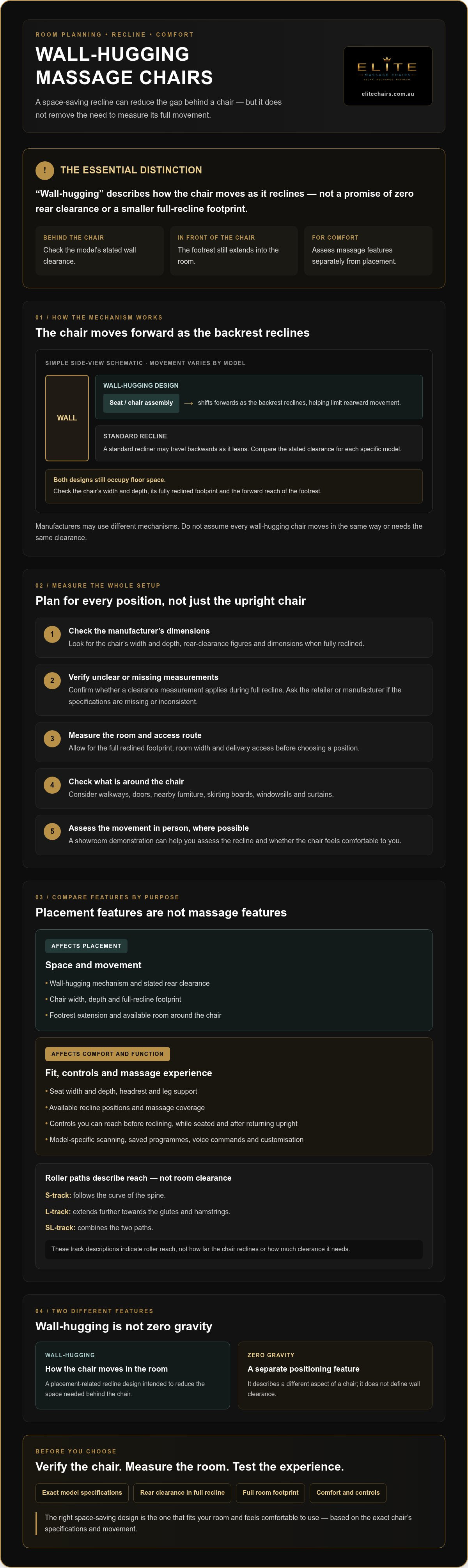
A wall-hugging massage chair moves forwards as it reclines, reducing the space it needs behind it. This can make placement easier in a tighter room, but “wall-hugging” describes the recline design. It doesn’t promise that the chair can sit directly against a wall. Check the clearance specified for the exact model before deciding where it will go.
Think of the label as a clue about how a chair moves, not a complete measure of the space it needs. The wall hugging massage chair features that affect placement are separate from its width, depth and full reclined footprint. A chair may need less space behind it and still extend a considerable distance into the room when reclined.
How the wall-hugging recline mechanism works
In a wall-hugging design, the seat or chair assembly shifts forwards as the backrest reclines, helping limit its rearward movement. Manufacturers may use different mechanisms, so don’t assume all wall-hugging chairs move in the same way or need the same clearance.
For a general introduction to how a reclining chair works, see Wikipedia’s overview. For a particular massage chair, rely on its product specifications and manual for the mechanism, required wall clearance and operating instructions. If the information doesn’t say whether a measurement applies during full recline, ask the retailer or manufacturer to clarify.
Wall-hugging versus standard massage-chair recline
A standard recliner may travel backwards as it leans, while a wall-hugging model is designed to move forwards and reduce the rear clearance needed. Compare the stated clearance for each specific model. Don’t rely on a general figure or assume the label means “zero clearance”. If measurements are missing or described inconsistently, verify them before planning the chair’s position.
Neither design is footprint-free. Both occupy floor space when upright and reclined, and the footrest can extend forwards into the room. Compare the chair’s width and depth alongside its wall clearance, then check whether the fully reclined position leaves enough room for walkways, doors and nearby furniture.
Wall-hugging refers to placement, not massage intensity, roller reach or treatment quality. Those depend on other model-specific features and your comfort preferences. Comparing the space-saving mechanism separately from the massage experience helps you assess each chair on its actual specifications.
Which wall-hugging massage chair features affect comfort and function?
A space-saving recline mechanism tells you how a chair moves in your room, not what kind of massage it delivers. Reduced rear clearance doesn’t establish massage capability. Roller coverage, recline positions, controls and body fit are separate considerations, and specifications vary by model. Check each feature against the manufacturer’s information rather than assuming every chair labelled wall-hugging offers the same experience.
Recline range, positioning and massage coverage
Check which positions are available and whether the chair can reach them in the spot you have planned. A model may recline near a wall, but consult its clearance requirements and manual to confirm how much space each position needs. If possible, assess the movement in person.
Keep recline range separate from massage coverage. For example, an S-track follows the curve of the spine, while an L-track extends further towards the glutes and hamstrings. An SL-track combines the two paths. These descriptions indicate roller reach, not how far the chair reclines or how much clearance it needs. Consider which areas you want covered, then assess how each position feels to you. For background on elevated-leg positioning, see this zero-gravity massage chair guide. Zero gravity and wall-hugging describe different aspects of a chair.
Controls, body fit and ease of use
Consider how you’ll operate the chair during a session. Check whether the remote or touchscreen is easy to reach before reclining, while seated and after returning upright. If a chair offers voice commands or saved programmes, confirm which controls and functions are included on that specific model.
- Seat dimensions: Compare the seat width and depth with your body fit, and check how the headrest and leg support feel.
- Body scanning: If advertised, verify what the scan adjusts and whether it’s included on the specific model.
- Customisation: Check which massage settings you can change, such as area, speed or intensity. Don’t assume every chair offers the same options.
The useful wall hugging massage chair features are those that work in your room and feel comfortable to use. Specifications help narrow the options, while a showroom demonstration can let you try the controls, fit and recline for yourself. Explore massage chair options and showroom demonstrations as part of your comparison.
Wall-hugging massage chair versus standard design: what should you compare?
A wall-hugging label doesn’t mean a chair will fit every small room. Compare the published measurements for the specific models you’re considering, and check what each figure describes. If a clearance or reclined dimension is missing, unclear or inconsistent across product information, verify it rather than guessing.
| What to compare | Wall-hugging design | Standard recline design |
|---|---|---|
| Rear clearance | Use the manufacturer’s stated clearance during recline. If it’s not published, verify it. | Check the manufacturer’s stated clearance during recline. Don’t assume it matches another standard design. |
| Overall dimensions | Compare width and depth upright and fully reclined, where provided. | Compare width and depth upright and fully reclined, where provided. |
| Recline | Confirm which positions are available and whether the dimensions include full recline. | Check the same details, including the chair’s movement behind and in front. |
| Room access | Check delivery access and space around the chair, not just the wall gap. | Check delivery access and space around the chair, not just the wall gap. |
Clearance, footprint and room layout are different measurements
Rear clearance is the space needed behind a chair as it moves through its recline. Footprint is the floor area it occupies in a stated position. Neither measurement alone tells you whether the chair will work in your room. Check width and depth, then consider doorways, walkways, nearby furniture and the space needed to approach and use the controls.
For broader context on weighing massage functions and other specifications, see this massage chair buying guide.
Potential trade-offs to check before choosing
A smaller wall gap may give you more flexibility when positioning a chair, but the full reclined dimensions still determine how much floor space it uses. Check that the chosen position won’t obstruct controls or access, and compare each model’s measurements on the same basis. If the manufacturer doesn’t specify whether a dimension includes full recline, ask for clarification before relying on it.
Keep the decision criteria separate: clearance affects placement, while comfort and massage functions relate to your preferences and the chair’s specifications. The wall hugging massage chair features worth prioritising depend on both. A showroom demonstration can help you assess fit and reclining comfort. Explore massage chair showroom demonstrations as part of your comparison.
How to measure your room before choosing a wall-hugging massage chair
Start with the spot you have in mind, not the chair’s “wall-hugging” label. A simple room plan can show whether the chair, its movement and your everyday walkways will fit together. Gather the manufacturer’s dimensions and clearance details for the exact model, and confirm anything that’s missing or unclear before ordering.
Measure the chair space and its movement path
- Mark the proposed position. Note which way the chair will face and where its base will sit. Measure the available floor area around the intended position.
- Record the room width and access routes. Measure the space between walls and note doorways, hallways and walkways the chair must pass through on delivery. Check whether furniture or other obstacles narrow those routes.
- Write down the chair dimensions. Record the manufacturer’s stated width and depth. Check whether dimensions are given for the upright position, full recline or both, and compare like with like.
- Add the specified rear clearance. Note how much space the model needs behind it while moving. If the specification doesn’t say which recline position the figure applies to, ask the retailer or manufacturer to clarify.
- Map the surrounding details. Account for nearby walls, furniture, curtains, windowsills and skirting boards. Check power access and leave enough circulation space to approach and use the chair without squeezing past obstacles.
These checks help you assess the real layout, not just whether the chair can sit close to a wall. The footrest and chair body still need room as it reclines, and delivery access and walkways matter too. Keep your measurements with the product details so you can compare models consistently.
Test real-world comfort before committing
Measurements can help confirm whether the chair may fit, but they can’t tell you how easy it feels to use. If a demonstration is available, try getting into and out of the chair, and test your preferred recline positions. Check whether the controls remain within comfortable reach as you move.
For tips on preparing for an in-person trial, read this massage chair demonstration guide. A showroom demonstration can help you assess fit and reclining comfort, while the model’s verified specifications remain essential for checking the measurements at home.
Ready to assess comfort in person? Book a massage chair showroom demonstration and compare the experience with your room measurements.
Choose with confidence: verify the chair, the room and the experience
Reduced rear clearance can help when space behind a chair is limited, but it doesn’t settle the fit question on its own. The chair still needs room to recline, and your room measurements remain decisive. Treat “wall-hugging” as a feature to verify for the exact model, not a guarantee that it will suit every compact layout.
A quick decision checklist for Australian shoppers
Match the manufacturer’s specifications to your measurements and the way you plan to use the chair. Check each point before deciding:
- Exact model: Confirm the model name and check its current manufacturer-published specifications.
- Dimensions and clearance: Compare the chair’s width and depth, including full-recline dimensions where provided, with your available space. Verify the stated rear clearance and which position it applies to.
- Recline: Check which positions are available and whether the chair can use them in your planned location.
- Comfort: Consider whether the seat, support and massage functions suit your preferences and routine.
- Controls: Make sure the controls feel accessible and straightforward to use.
- Delivery access: Check doorways, hallways and other parts of the route into the room, as well as the final chair position.
If a measurement is missing or unclear, ask the retailer or manufacturer to confirm it before ordering. Don’t assume that specifications from one chair apply to another, even if both are described as space-saving.
What to ask during a massage chair demonstration
A demonstration can help you judge comfort and ease of use, but confirm that the chair being demonstrated is the same model you’re considering. Ask whether it uses a wall-hugging mechanism, and request the model’s rear-clearance and full-recline figures. Try the positions you expect to use, and check whether you can comfortably reach the controls as the chair reclines.
Also check whether the model is currently available and ask about delivery access and relevant purchase terms. Elite Massage Chairs offers showroom demonstrations, but confirm current product details rather than assuming a wall-hugging model is available. The wall hugging massage chair features that matter most are those that suit your room and feel right in practice.
Ready to try a chair in person? Book a free chair demonstration and assess the comfort and controls before you decide.
Make room for a more considered choice
A wall-hugging mechanism can reduce the space needed behind a chair, but it doesn’t guarantee that the chair will suit a smaller room. Check the exact model’s rear clearance and full-recline dimensions, then consider its width, room for movement and delivery access. Compare those measurements separately from massage coverage, controls and comfort, which depend on the individual chair and your preferences.
The most useful wall hugging massage chair features are those that work for both your room and your everyday routine. Verify specifications with the manufacturer or retailer, and try the chair in person if you can. A demonstration lets you assess how the recline feels, whether the controls are easy to reach and whether the chair suits your body.
Elite Massage Chairs is an Australian retailer of premium massage chairs, with free showroom demonstrations available. Confirm current booking details and the specifications of any chair you’re considering. Book a free massage chair demonstration and explore your options, then decide with your measurements and preferences in mind.
Frequently Asked Questions
What does wall-hugging mean in a massage chair?
A wall-hugging massage chair moves forwards as it reclines, reducing the space needed behind it. The mechanism can make placement more flexible, but “wall-hugging” doesn’t guarantee zero clearance or describe the chair’s massage performance. Check the specific model’s manual and manufacturer specifications for how it moves and the clearance it needs. Assess other wall hugging massage chair features, such as roller coverage and controls, separately.
How much space does a wall-hugging massage chair need behind it?
The required rear clearance depends on the model, so check its manufacturer-published measurement rather than relying on the label alone. True wall-hugger designs are commonly described as needing around 4 to 6 inches behind them, but that isn’t a universal specification. Confirm whether the figure applies during full recline, and check the chair’s overall dimensions too. If the clearance information is missing or unclear, ask the retailer or manufacturer before ordering.
Can a wall-hugging massage chair sit directly against a wall?
Only if the manufacturer confirms that the specific model is designed for zero wall clearance. “Wall-hugging” generally means the chair moves forwards as it reclines to reduce the gap behind it, not that it can touch the wall. Follow the model’s placement instructions and account for skirting boards, windowsills and curtains. Even with minimal rear clearance, the chair and footrest still need room to move forwards as it reclines.
Is a wall-hugging massage chair better than a standard massage chair?
Neither design is automatically better. The right option depends on your room and preferences. A wall-hugging mechanism may help if space behind the chair is limited, while a standard design may suit a layout with more room to recline. Compare verified clearance and full-recline dimensions, then assess comfort, massage functions and controls separately. Choose a chair that fits the room and feels comfortable to use.
Do wall-hugging massage chairs have the same massage features as other chairs?
They may, but wall-hugging describes the chair’s space-saving recline mechanism, not its massage functions. Roller coverage, massage programmes, intensity settings and controls vary by model. Check the manufacturer’s specifications for each feature you care about, and don’t infer massage capability from a wall-hugging label. If possible, try the chair to see how its massage and recline positions feel before deciding.
How do I measure my room for a wall-hugging massage chair?
Start by marking the intended chair position and measuring the available room width and floor area. Compare these with the manufacturer’s chair dimensions, including full-recline dimensions if provided, and record the specified rear clearance. Also check doorways and delivery access, walkways, nearby furniture and power access. If the measurements don’t say which position they cover, confirm the details with the retailer or manufacturer before ordering.
Can I try a massage chair before buying it in Australia?
Yes. Elite Massage Chairs offers free showroom demonstrations, where you can assess a chair’s fit, comfort, recline and controls in person. Confirm current booking details and which models are available to try before visiting. A demonstration can help you judge the experience, but it doesn’t replace checking the exact model’s published dimensions and clearance against your room. Confirm current availability rather than assuming a wall-hugging model is available.


