

What if the best high end massage chair isn’t the one with the longest feature list, but the one you actually feel comfortable using? Premium technology can offer more ways to adjust a massage, but specifications alone can’t tell you whether the chair’s support, pressure and controls suit you. Before choosing, think about what you want from the experience and which features would make a difference in your routine.
This guide explains how to compare roller movement, track design, zero-gravity recline and ease of use without getting lost in jargon. You’ll also find practical checks for comfort, controls and room fit. A free showroom demonstration gives you the chance to try a chair, adjust its settings and decide how it feels before you buy. The aim is to find an option that suits your preferences as part of a home relaxation routine, not to judge a chair by its feature list alone.
Key Takeaways
- Judge premium value by how comfort, thoughtful design and useful technology work together, not by price or feature count alone.
- Learn how rollers, body scanning and air compression can shape the feel of a high end massage chair, without treating technology labels as guarantees.
- Separate personal relaxation preferences from medical claims, and consider whether a chair’s sensations suit you.
- Use a practical checklist to assess body fit, preferred massage feel, room dimensions, access and placement before choosing.
- A showroom demonstration lets you try the controls and experience a chair firsthand, rather than relying on specifications alone.
What makes a high-end massage chair different from a basic model?
Premium value comes from the way comfort, design and useful technology work together. A high end massage chair isn’t defined by its price tag or the number of features on a product page. It should offer an experience you enjoy using, with settings and support that suit your preferences.
Compare the details that affect everyday use. Does the massage feel comfortable at a setting you’d choose again? Can you adjust it without interrupting your break? Are the controls easy to understand? A basic model may offer a straightforward experience, while a premium chair may give you more ways to tailor the sensation or position. Extra choice is useful only when it helps you find a setting you like.
A high-end massage chair brings considered comfort, coherent design and practical personalisation together in a form that feels right for the person using it.
Which qualities make a chair feel genuinely premium?
Look beyond the feature list and assess details you can experience for yourself. Does the upholstery feel pleasant against your skin? Can you reach and understand the controls while seated? Does the chair support you comfortably as it reclines? These are practical points to check, even though the answer to “does this feel good?” will be personal.
How the elements work together matters. Advanced functions may be less appealing if the support doesn’t suit your body or the controls are awkward to reach. A soft seat isn’t automatically the right seat either: you may prefer a cushioned feel or firmer support. During a trial, notice how your shoulders, back and legs rest. Then change position and see whether the support still feels comfortable.
For a broader introduction to the history and types of massage chairs, it helps to see how designs have developed from simpler forms to more feature-rich options. That context is useful, but your own comfort remains the more practical test.
Does more technology always mean a better massage?
No. Additional settings are valuable when they’re easy to understand and relevant to the way you like a massage to feel. If a control lets you adjust intensity or choose a different programme, change one setting at a time. That makes it easier to tell what each option changes than switching through several features quickly.
Customisation gives you options for a gentler or more pronounced sensation, but it doesn’t mean a chair can diagnose a problem or promise a particular health outcome. Judge each feature by the experience it enables: can you find a setting you enjoy, make a simple adjustment and return to it without a frustrating learning curve?
That’s the practical difference between technology that supports everyday use and technology that merely sounds impressive. Personalisation should feel approachable, not like another task to master.
How massage chair technology shapes a more personalised experience
Technology can change how a massage feels, but a feature name alone won’t tell you whether you’ll enjoy it. In a high end massage chair, rollers may travel along the back, sensors may help position their movement, and air cells may add a gentle squeezing sensation around areas such as the arms or legs. Functions and settings differ between chairs, so understanding the basics can help you compare them.
Personal comfort depends on both the chair’s design and the preferences of the person using it. A mechanism that feels soothing to one person may feel too intense or unfamiliar to another.
What do 3D and 4D massage mechanisms mean?
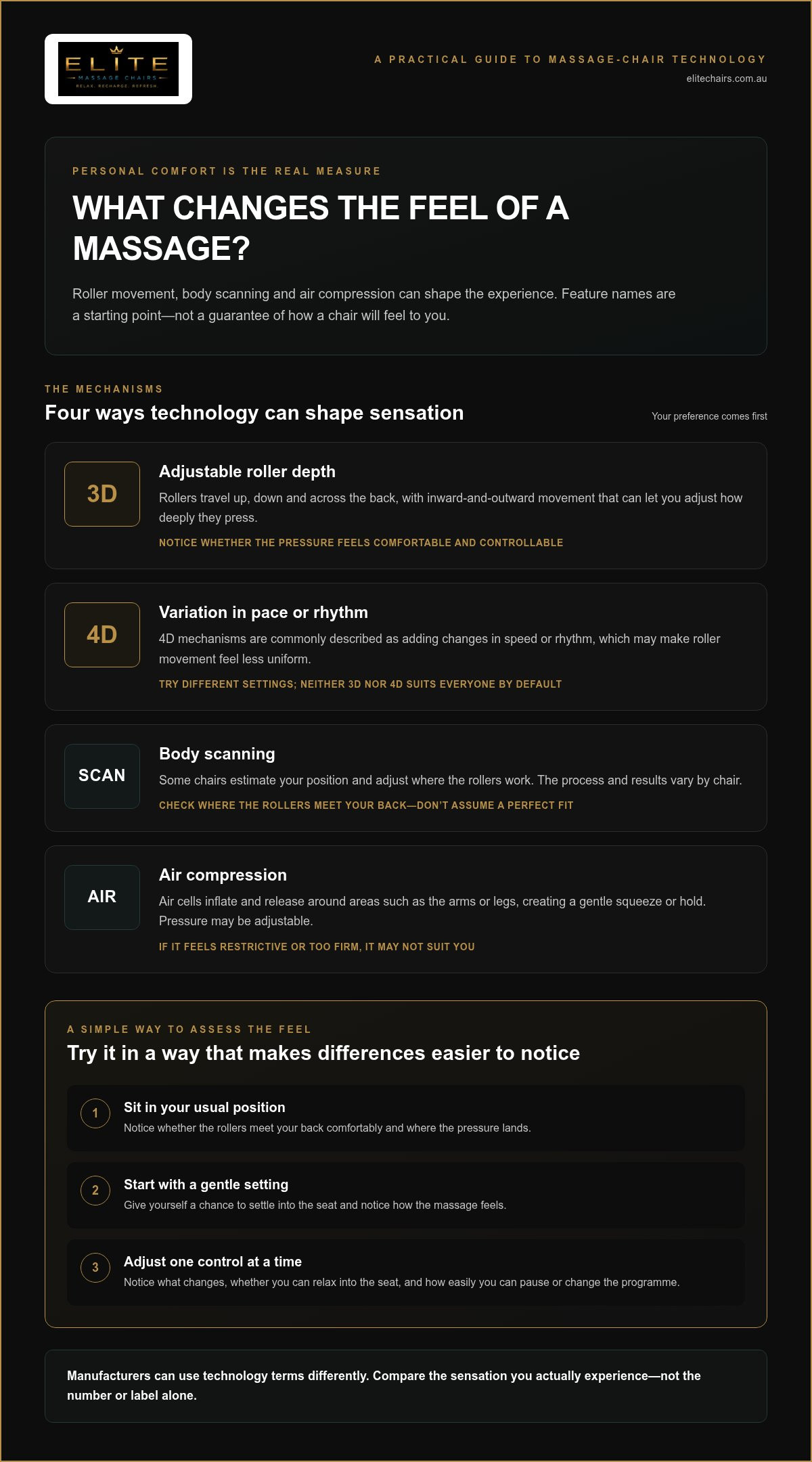
In general, 3D mechanisms add movement inwards and outwards to rollers that travel up, down and across the back. This can let users adjust how deeply the rollers press. 4D mechanisms are commonly described as adding changes in speed or rhythm, which may make the movement feel less uniform. Manufacturers can use these terms differently, though, so they don’t guarantee a particular sensation or level of quality.
Focus on how the massage feels, not the number. A slower, lighter movement might feel more comfortable to you than a deeper or more varied one. Try different settings and notice whether changes in depth, pace or rhythm feel pleasant and controllable. Neither 3D nor 4D is automatically better for everyone.
How do body scanning and air compression affect comfort?
Some chairs use body scanning to estimate the user’s position and adjust where the rollers work. This may help the massage align with your seated position, but the process and results vary by chair. Notice whether the rollers meet your back comfortably rather than assuming a scanning feature will create a perfect fit.
Air compression feels different from roller movement. Air cells inflate and release around parts of the body, creating a gentle squeeze or hold. The pressure may be adjustable, but your preference is what matters. If it feels restrictive, too firm or simply not relaxing, that feature may not suit you.
For useful context on how designs have evolved, Wikipedia’s overview of the history and types of massage chairs covers traditional and robotic chairs. Treat feature descriptions as a starting point, then consider how the chair feels in practice. Sit in your usual position, start with a gentle setting and adjust one control at a time. Notice where pressure lands, whether you can relax into the seat, and how easily you can pause or change the programme.
Features vary by chair, and a combination that feels intuitive to one person may be distracting to another. A free showroom demonstration at Elite Massage Chairs gives you a practical way to experience the controls and sensations before deciding what suits you.
High-end massage chair concerns: comfort, claims and everyday use
Advanced features offer more ways to adjust a massage, but they can’t guarantee that the sensation will suit you. Pressure that feels soothing to one person may feel too firm to another, and a chair’s support or movement may not match every body. Assess comfort for yourself rather than relying on a premium label.
There are practical trade-offs, too. A massage chair needs enough room to fit and recline, and its controls may take time to learn. Roller movement or air compression can feel unfamiliar at first. A showroom demonstration lets you try these details before deciding, rather than relying on feature descriptions alone.
Can a premium chair suit different comfort preferences?
People vary in the pressure, pace and support they find comfortable. Adjustable settings give you options, but they don’t guarantee a perfect fit. If you try a chair, begin gently and notice how it feels across your back and body as the session progresses. Stop if a sensation feels uncomfortable. If you have health concerns or are unsure whether massage is suitable for you, seek advice from an appropriate health professional.
What should shoppers expect from a massage chair?
A massage chair can be part of a home relaxation routine, but it isn’t a substitute for professional care, diagnosis or treatment. Be wary of claims that promise a specific health result. Instead, focus on what you can assess directly: whether the chair feels comfortable, whether you can adjust its settings with ease, and whether the experience helps you unwind.
A massage chair may support personal comfort and relaxation, but it shouldn’t be treated as medical care or a promise of health outcomes.
Everyday use matters as much as the first impression. Consider where the chair will sit, how much clearance it needs to recline, and whether you can reach the controls from your usual position. A setting that seems appealing on paper may take practice to adjust, so think about whether you’re comfortable learning the controls and finding an intensity that feels right.
Expectations also shape satisfaction. A chair may provide a welcome pause at home, but the feel of a massage is personal and can change with your mood, posture and chosen settings. You may prefer a simpler sensation over a more intense one. The goal isn’t to use every function; it’s to find an experience you’re comfortable returning to.
For a broader discussion of realistic wellness expectations and massage chairs, explore this therapeutic massage chair guide. It can help you keep comfort and relaxation in perspective as you consider whether a high end massage chair suits your routine.
How to assess a high-end massage chair before choosing
A hands-on assessment turns a list of features into a clearer sense of what suits you. Use the same checks for each chair, and give yourself time to notice comfort and controls instead of trying to judge everything at once.
- Start with body fit and preferred sensations. Sit naturally and check whether the headrest, back, seat and leg support feel comfortable. Consider whether you prefer a lighter touch, firmer pressure or a slower pace.
- Try the available settings gradually. Begin gently, then adjust one setting at a time. Notice where pressure lands and whether the sensation stays comfortable as the massage moves between areas.
- Explore the controls. Check whether you can understand the buttons or screen, change a setting and pause the massage without confusion. Imagine using those controls when you want a quiet, uncomplicated break.
- Assess support as the chair moves. Recline and check whether your body remains comfortably supported. Notice if any part of the chair feels restrictive or if you’d want to change your position.
- Measure your space and access route. Check the intended floor area, clearance needed for reclining, and the route through doorways or hallways. Consider power access and whether the chair’s placement will leave enough room to move around it.
- Picture ordinary use at home. Think about where the chair fits into your routine and how often you’d realistically use it. Focus on daily comfort and ease, not assumptions about long-term results.
What should you notice during a chair demonstration?
Move at a comfortable pace. Try a setting, pause to register the pressure, then make a small adjustment before moving on. Notice whether support feels suitable around your head, back, seat and legs, and whether changing a programme or intensity feels clear. If a sensation is uncomfortable, stop or select a gentler option. A demonstration should give you space to explore, not pressure to decide quickly.
For more structure before trying chairs, the massage chair demonstration guide outlines how to prepare for a hands-on assessment. Note your preferred pressure and any areas where support matters most, then use those same points to compare each chair.
How can you compare chairs for your home?
Use consistent criteria rather than trying to remember which chair seemed best. After each trial, jot down a few words about fit, pressure, pace, control clarity and overall comfort. A high end massage chair should suit your body and your home, not just look impressive on a specification sheet. Measure the access route as well as the space the chair will occupy once positioned.
Experience the comfort and controls for yourself with a free showroom demonstration. It’s a practical way to compare your preferences before choosing.
Experience a high-end massage chair with Elite Massage Chairs
A product description can explain what a chair is designed to do, but it can’t tell you how the seat will feel or whether the controls make sense in your hands. A free showroom demonstration is a practical way to try those details for yourself before making a decision based on specifications alone.
What can a showroom demonstration help you decide?
Use the time to notice your own response. Try available settings at a comfortable pace, paying attention to how the massage feels across your back, shoulders and legs. Check whether the chair supports you comfortably, the pressure feels right, and you can adjust the settings without interrupting your sense of ease.
A demonstration can also help you compare preferences you may not have considered. Perhaps you like a gentler touch, or a particular reclined position feels more relaxing. If that position interests you, this zero gravity massage chair guide offers more context about the reclining design.
Take your time with the controls. Change one setting at a time and note which options feel intuitive and genuinely useful. The aim isn’t to test every feature; it’s to understand how the chair feels to you and whether you can picture using it at home. That firsthand experience can make choosing a high end massage chair feel clearer and more considered.
What are the next steps after trying a chair?
Before you leave, recap what mattered most: comfortable support, preferred pressure, settings you’d use and controls you found easy to manage. If you tried more than one chair, compare them against those same points rather than relying on a general first impression. Your notes can keep the decision grounded in your priorities.
Elite Massage Chairs offers online shopping as well as showroom demonstrations, so you can explore the range in the way that suits you. Flexible financing through Humm is also available as an option to consider; review its information as part of your decision.
Let your experience guide you. A chair may have an impressive list of functions, but the more useful question is whether its comfort and everyday controls feel right for you. To experience a chair firsthand, book a free showroom demonstration and take a considered step towards finding your fit.
Choose a chair that feels right for you
Your next step doesn’t need to be a quick decision. Think about the sensations and support you preferred, then consider which chair feels comfortable enough to become part of your home routine. The right high end massage chair is a personal choice, shaped by how you feel in it rather than by a feature list alone.
Elite Massage Chairs serves customers across Australia, with the option to explore chairs online or experience them in the showroom. Humm financing is also available as a flexible purchasing option to consider as you plan your choice.
Try a chair before deciding. Book your free showroom demonstration and take a considered step towards finding a chair that feels like a natural fit for your home.
Frequently Asked Questions
What makes a massage chair high-end?
A high-end massage chair brings together considered comfort, thoughtful construction and technology that’s useful in practice. Look for details that suit your priorities, such as controls you can operate easily or settings that let you adjust the massage. A long feature list alone doesn’t establish quality. Consider whether the chair feels well designed for regular use and whether its functions make the experience more comfortable for you.
Is a high-end massage chair worth it?
It may be worthwhile if you’ll use the chair regularly and its comfort, adjustment options and everyday controls suit you. Think about how it fits your routine, where it will go and which features you’re genuinely likely to use. If you’re unsure, compare the experience with your needs rather than deciding by specification count. Humm financing is available as a flexible purchasing option to consider alongside your budget.
Can you try a massage chair before buying one?
Yes. Elite Massage Chairs offers free showroom demonstrations, so you can experience a chair before deciding. Sit in your usual posture, explore the controls and notice whether the seat and massage feel comfortable. You can book a demonstration through the showroom, or browse and purchase through the online store if that better suits how you prefer to shop.
How do I know if a massage chair will fit my body?
Try sitting in the chair with your back against the support and feet resting naturally. Notice whether the headrest meets your head comfortably, your shoulders sit without strain, and the leg support feels suitable. If you’re taller or shorter than average, pay particular attention to where the massage meets your back and legs. A hands-on trial is more informative than assuming one chair will suit every body.
Can a massage chair replace a massage therapist or physiotherapist?
No. A massage chair is designed for home comfort and relaxation, not to assess symptoms or provide individualised professional care. A massage therapist or physiotherapist can respond to your needs in ways a chair cannot. If you’re managing pain, an injury or another health concern, seek advice from a qualified health professional about appropriate care and whether using a massage chair is suitable for you.
Are massage chairs suitable for everyday use?
Suitability depends on the chair’s instructions, your comfort and your individual circumstances. Start with a gentle setting and a shorter session, then pay attention to how you feel during and afterwards. Don’t continue if the massage causes discomfort. Follow the manufacturer’s guidance for use, and seek advice from a health professional if you have a condition, take relevant medication or are uncertain whether massage is appropriate for you.
What should I look for in a massage chair demonstration?
Use the demonstration to check more than the first impression. Try adjusting the intensity, changing a setting and stopping the massage, so you can see whether the controls feel straightforward. Notice how support changes as you recline and whether pressure feels comfortable across different areas. If comparing chairs, use the same preferred settings and body positions for each, then note which experience feels easiest to settle into.


