

A massage chair isn’t ordinary furniture, so moving it like a sofa can put its mechanism, upholstery and electrical components at risk. If you’re wondering how to move a massage chair without damaging it or straining yourself, plan around its design, not just its size.
A bulky chair can be difficult to steer through doorways, and the wrong lifting or transport method may harm the chair or your home. This guide explains how to prepare the chair and route, follow the manual’s model-specific instructions, and reduce risk when lifting and securing it for transport.
You’ll also learn when a careful DIY move may be manageable and when a furniture delivery service offering hands-on handling may suit the job better, particularly if the route involves stairs, tight turns or disassembly. A measured plan can help protect your chair and make it easier to set up in its new space.
Key Takeaways
- Base your moving plan on the chair’s mechanisms and model-specific manual, not its appearance as standard furniture.
- Before lifting, check the manual, map the route, clear obstacles and organise suitable help and equipment.
- Choose between DIY and professional handling by weighing the route’s difficulty against the support you need; service inclusions can vary.
- To move a massage chair safely, avoid lifting by armrests, the footrest or other moving parts unless the manual allows it.
- Once the chair is in place, follow the manual for clearance, reconnection and testing before returning to your routine.
How to move a massage chair: understand the risks before you lift
Massage chairs are bulky, powered furniture with moving mechanisms, not ordinary recliners. Their shape can disguise an uneven centre of weight, while motors, wiring and massage components sit inside the frame. A chair that looks sturdy may not have safe handholds where you expect them.
A safe massage-chair move protects the people handling it, the chair’s structure and upholstery, and its internal components from strain, impact and unnecessary movement. Check the model’s instructions before shifting or tilting the chair, rather than judging by appearance alone. Designs vary, including zero-gravity models, so don’t assume two chairs can be handled in the same way.
Why a massage chair needs more care than an ordinary recliner
A recliner’s frame and cushioning are generally easier to understand from the outside. A massage chair can have a wider, more awkward profile and weight concentrated unevenly through its base or powered sections. Twisting it around a corner, dragging it across flooring or lifting it by a section that moves can place force on parts not designed to bear it.
Before moving or tilting the chair, consult its specific manual. Follow its directions for safe handling and transport preparation, and don’t infer grip points from the upholstery or frame. Moving straps, including a shoulder dolly, may help distribute a load during some moves, but they aren’t automatically suitable for every chair or route. Use them only if they’re compatible with the chair’s instructions and the people handling it.
When a DIY move may not be the right choice
Pause before attempting the move if the route includes stairs, tight turns, a long carry or awkward access. Each can make it harder to keep the chair stable and protect door frames, walls and floors. Limited lifting capacity, too few helpers or uncertainty about where the chair can safely be held are also good reasons not to improvise.
Professional furniture handling may be worth considering if the chair can’t be moved along a clear, manageable route without twisting or risky lifting. Choose the approach that protects both your wellbeing and the chair. If you’re unsure, don’t test the chair’s balance by lifting it; use its manual to guide the next step.
Prepare a massage chair for moving: check the manual, route and equipment
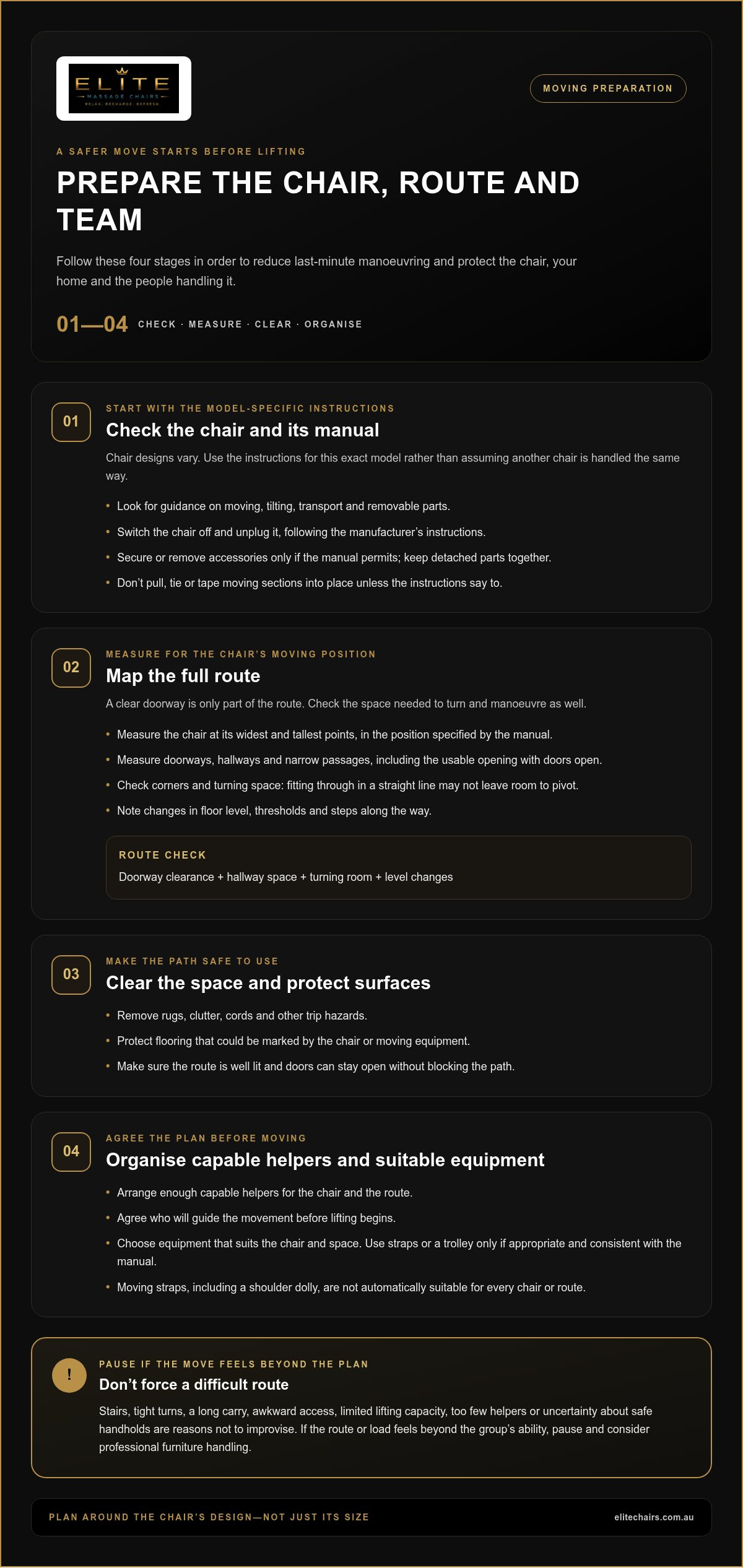
Methodical preparation makes lifting safer and helps prevent last-minute manoeuvring. Before deciding how to move a massage chair, work through these steps in order: check the model’s manual, plan the route, clear the space, then gather suitable helpers and equipment.
Check the chair and its instructions first
Find the owner’s manual and look specifically for instructions on moving, tilting, transport and any parts that can be removed. Chair designs vary, so don’t rely on instructions for a different model or assume a feature can be secured in a particular position.
Switch the chair off and unplug it before preparing it, following the manufacturer’s instructions. Secure or remove accessories only if the manual permits, and keep detached parts together so they’re easy to identify later. Don’t pull, tie or tape moving sections into place unless the instructions say to do so.
Plan the route and gather suitable moving equipment
Measure the chair at its widest and tallest points in the position the manual specifies for moving. Then measure doorways, hallways and other narrow passages, including the usable opening with doors open. Check corners and turning space too: a chair may fit through a doorway in a straight line but leave too little room to pivot. Note changes in floor level, thresholds and steps along the way.
Clear rugs, clutter, cords and other trip hazards, and protect flooring that could be marked by the chair or moving equipment. Make sure the route is well lit and that doors can remain open without obstructing the path. The HSE manual handling guidelines offer general information on assessing handling risks. For your chair, its own manual remains the guide to model-specific moving instructions.
Arrange enough capable helpers for the chair and route, and agree who will guide the movement before lifting begins. Choose equipment suited to the chair and space, but use straps or a trolley only if they’re appropriate and don’t conflict with the manual. If the route or load feels beyond the group’s ability, pause rather than trying to force the move.
Before lifting, check the manual, measure and clear the route, protect the floors, and organise capable helpers and suitable equipment. Careful preparation helps protect your chair. If you’re exploring chair designs for your home, take a look at the massage chair range.
DIY move or white-glove furniture delivery service: compare the options
A short move isn’t automatically a simple one. Moving a chair between rooms involves less transport, but a doorway, tight turn or step can still make handling difficult. A white-glove furniture delivery service generally describes a more hands-on approach to delivery and placement than a basic drop-off, but inclusions vary. Compare the stated scope rather than assuming disassembly, reassembly, stairs or testing are covered.
To decide how to move a massage chair, consider the whole route, the lifting involved and how confident you feel handling a powered chair. Use this comparison as a starting point:
| Factor | DIY move | Professional handling |
|---|---|---|
| Access | More manageable on a clear, level route with room to manoeuvre. | May suit routes with stairs, tight turns or awkward access. |
| Lifting | Depends on having capable helpers and following the chair manual. | Can reduce the lifting you need to do yourself; the actual support depends on the service. |
| Transport and placement | You organise the equipment, transport and positioning. | Delivery and placement may be included, but the exact scope varies. |
| Reassembly | You follow the model’s instructions for any parts removed. | Assembly support can differ between services; compare the stated inclusions. |
When moving the chair yourself may be manageable
A short, level route with clear access is generally less complex than carrying a chair up stairs or turning it through a narrow hallway. DIY may suit the move if you have enough capable helpers, appropriate equipment and clear instructions for your specific model. If you can’t identify safe handling points or the manual’s directions are unclear, don’t guess or proceed with a lift you can’t control.
When to consider white-glove furniture handling
Stairs, difficult access, substantial lifting or the need to transport the chair can make specialist furniture handling worth considering. A more supported move may bring added peace of mind when protecting a considered investment in home comfort. Compare the service’s stated scope with the tasks you need, including delivery, placement and any assembly or reassembly.
Choose based on the most challenging part of your move, not simply the distance. If the route, handling or chair-specific instructions leave you uncertain, pause and consider an option that better suits the task.
How to move a massage chair safely: lift, manoeuvre and transport it
Once the route is ready, keep the move controlled from the first lift to the final placement. The chair’s manual takes precedence over general advice: if its instructions differ from these steps, follow the manufacturer’s directions. If you can’t move the chair without forcing it or losing control, stop and reconsider the plan.
Lift and manoeuvre with control
- Agree on the move before lifting. Make sure each helper knows the route, where to pause and who will guide the chair through doorways. Decide on hand positions using only the grip points allowed by the manual. Don’t lift by the armrests, footrest or other moving parts unless the manufacturer explicitly permits it.
- Lift together and move steadily. Follow the manual’s instructions for lifting or tilting, keeping the chair balanced and avoiding sudden movements. Communicate clearly as you move, especially at corners and thresholds. Don’t twist your body while carrying or jerk the chair to clear an obstacle.
- Pause to reposition when needed. Keep the route clear and take small, controlled steps. If the chair needs adjusting, set it down safely before changing grip or direction. Stop if it shifts unexpectedly, catches on an obstacle or feels unsafe to carry. Never try to recover control with a sudden twist.
These steps can help you understand how to move a massage chair while reducing avoidable strain and impact. They don’t replace model-specific directions. If the manual doesn’t explain a lift or tilt you’re considering, don’t improvise.
Protect the chair during vehicle transport
Choose a vehicle with enough room to carry the chair in an orientation approved by the manufacturer. Don’t lay it on its side or back unless the manual explicitly allows that position. If it won’t fit as directed, don’t force it into the vehicle or assume a different orientation will be safe.
Before loading, protect the upholstery and finish with suitable coverings that won’t snag on the chair or obstruct securement. Position the chair as the manual specifies, then secure it against movement using only appropriate restraint points and methods. Keep restraints clear of controls, cables and moving sections, and make sure the chair can’t slide or tip during the journey. Follow any further transport instructions in the manual.
At the destination, unload at the same measured pace. Resist the urge to rush, even if the journey is short. To explore massage chair designs for your home, view the massage chair range.
After moving your massage chair: set it up carefully and restore your routine
Once the chair is in its new position, check it before settling back into your usual routine. The final stage of how to move a massage chair safely is making sure it’s assembled, positioned and powered according to the manufacturer’s instructions.
Reassemble and check the chair before using it
Reinstall only components removed in line with the manual, and make sure each is secure as instructed. Before reconnecting power, inspect the chair’s upholstery and structure, along with its cable and plug. If you notice visible damage, don’t plug the chair in or use it.
Reconnect the power and check the functions only after setup is complete and the manual permits it. Follow the manufacturer’s testing instructions, and don’t force a mechanism that doesn’t move as expected. Stop using the chair if you notice unusual sounds, unexpected movement or any damage. A cautious check is better than trying to push through a possible problem.
Choose a comfortable position for everyday use
Position the chair where it has the clearance required for its movement, with practical access to the power point and controls. Use the manual’s guidance alongside your room layout, allowing enough space for the chair to operate without obstruction from walls, furniture or other items. Different chair designs can have different positioning needs; explore the zero-gravity massage chair guide for more on one design approach.
Once the chair is positioned comfortably and its functions have been checked as directed, you can return to your relaxation routine with greater confidence. A considered setup helps preserve the comfort and function you value without rushing the final step.
If you’re considering a massage chair for your home, experience one in person by booking a massage chair demonstration.
Move with care, then make space for everyday comfort
A safe move starts with the chair’s own instructions, a clear route and a realistic assessment of the lifting involved. Understanding how to move a massage chair means respecting its powered mechanisms, choosing controlled handling over rushing, and checking the chair carefully before reconnecting or using it in its new home.
If stairs, tight access or uncertain grip points make the move feel unsafe, pause and consider whether professional furniture handling is a better fit. Once the chair is in place, follow its manual for positioning, clearance and function checks so your home wellness routine can resume with confidence.
When you’re ready to explore a chair for your home, Elite Massage Chairs offers premium massage chairs and wellness solutions online and in-store. Book a free showroom demonstration to experience a chair before choosing, or explore premium massage chairs for your home.
Frequently Asked Questions
Can you move a massage chair yourself?
A DIY move may be manageable if the route is clear and level, you have enough capable helpers and suitable equipment, and the chair’s manual gives clear handling instructions. Stairs, tight turns, long carries or uncertain grip points increase the challenge. If you can’t keep the chair controlled without straining or forcing it, pause and consider professional furniture handling. Plan how to move a massage chair around its design, not just its size.
How do you prepare a massage chair for moving?
Start by reading the specific chair manual for moving, tilting and transport instructions. Switch the chair off and unplug it as directed, and remove or secure accessories only if the manual permits. Measure the chair and route, including doorways, corners and floor transitions. Clear obstacles, protect vulnerable flooring, then organise capable helpers and suitable equipment. Keep any removed parts together so they can be reinstalled correctly at the destination.
Can you lay a massage chair on its side to transport it?
Only lay a massage chair on its side if the manufacturer’s manual explicitly permits that position. The chair’s internal mechanism, frame and upholstery may be affected by an orientation that isn’t approved for transport. Follow the model-specific instructions and use a vehicle with enough room for an approved orientation. If the chair won’t fit as directed, don’t force it into a different position or assume it will be safe.
How many people does it take to move a massage chair?
There isn’t one safe number for every chair and route. The manual, chair design, access, equipment and lifting capacity of the people helping all matter. Organise enough capable helpers to keep the chair stable and follow the manufacturer’s handling directions. Agree on hand positions and movements before lifting. If the group can’t control the chair comfortably, especially on stairs or through tight turns, stop rather than attempting the move with too few people.
Is a white-glove delivery service worth considering for a massage chair?
It may be worth considering if the move involves stairs, difficult access, substantial lifting or transport you’d rather not manage yourself. White-glove delivery generally means a more hands-on approach to delivery and placement, but the exact scope varies. Compare the stated inclusions with the tasks you need, such as placement or assembly. Don’t assume any particular inclusion; match the support offered to the complexity of your route.
What should you check after moving a massage chair?
Position the chair with the clearance required by its manual and room layout. Reinstall only parts removed according to the instructions, then inspect the chair, cable and plug for visible damage before reconnecting power. Once setup is complete, test functions only as the manufacturer permits. Stop using the chair if you notice damage, unusual sounds or unexpected movement. Don’t force a mechanism that doesn’t behave as the manual describes.
Can moving a massage chair damage its mechanism?
Yes, careless handling can risk damage to the chair’s mechanism, structure or upholstery. Twisting, dragging, sudden tilting, or lifting by the armrests, footrest or other moving parts may put force where it isn’t intended, unless the manual specifically permits that handling. Reduce risk by following the model’s moving instructions, keeping movements controlled and securing the chair appropriately for transport. If it shifts unexpectedly or catches, stop and reassess rather than forcing it onward.


