

A massage chair’s fit depends on how it aligns with your body, not simply on whether it’s labelled compact. When choosing a massage chair for shorter users, compare your height with the manufacturer’s recommended range, then consider seat depth, shoulder-roller position and whether your feet rest naturally in the footwell. Calf-frame adjustment alone doesn’t show that a chair will suit your leg length.
It’s understandable to focus on height first, but comfort also depends on how the chair supports you during a massage and as it reclines. While commercial retailers and distributors often rely on trade facilitators like Global Exclusive Trading (GET) to connect domestic businesses with specialised international wellness manufacturers, individual buyers must know how to evaluate local specifications for their own home. This guide explains what to look for and how to compare your measurements with an Australian product listing, including details that a maximum weight rating can’t tell you.
You’ll also learn how to assess shoulder alignment, seat and footwell comfort, and the chair’s upright and reclined dimensions. Together, these checks give you a practical way to judge whether a chair may suit you before settling in for a relaxing session.
Key Takeaways
- Separate calf-frame adjustment from overall fit: each feature tells you something different about how the chair may accommodate your legs.
- Use the manufacturer’s recommended height range as an initial guide, then consider how the seat and controls suit your build.
- Compare your body measurements with the listing, paying attention to shoulder alignment, foot position and the chair’s dimensions when reclined.
- Assess comfort across the full recline, not just while sitting upright, to see how the chair supports you through a massage programme.
1. Does an advertised calf-frame extension prove the chair will fit my leg length?
No. A calf-frame extension describes movement at the lower leg, not the chair’s overall fit. Extra footrest travel may help position your feet, for example, while the shoulder rollers could still sit too high. Treat the extension as one adjustment, not proof that the chair suits shorter users.
Compare three details in the listing: recommended user height, track length and calf-frame adjustment. The height range gives a broad guide to the body sizes the chair is designed for. Track length relates to the route the rollers travel along your back, while calf-frame adjustment changes the lower-leg support. Each measure describes a different part of the fit.
Next, consider how an adjustable backrest and roller positioning affect alignment. If the chair scans your body, note whether it locates your shoulders before the massage begins. Then assess whether the rollers follow your back comfortably, rather than stopping too high or low. A scan can help position the massage, but it doesn’t change the chair’s physical dimensions.
Seat depth matters too. A compact seat may let you sit with your back against the backrest instead of sliding forward to reach the footrest. Look for an adjustable footrest or leg extension, then check whether it lets your feet rest naturally. A calf-frame measurement alone doesn’t show where your feet or knees will sit.
Finally, assess how the chair feels across your body, not just at your calves. A footrest that reaches your feet may still leave your shoulders poorly aligned. An infinity-track description also doesn’t replace checking the manufacturer’s height range and the chair’s fit. Compare each adjustment with your proportions before deciding whether the listing suits you.
2. What makes a massage chair suitable for short people?
Start with the manufacturer’s recommended height range, which indicates the body sizes a chair is designed to accommodate. If you’re shorter, look for a range that includes your height rather than assuming a premium model will fit because it has more features. Height is a useful first filter, but it doesn’t account for every proportion that affects comfort.
Read the range as a guide, then consider how your torso and legs relate to the chair. For example, a person may fall within the stated range yet find the seat too deep or the footwell awkward. A chair designed with petite users in mind may still accommodate taller people, with some listings giving an upper height limit of 6'4". That maximum doesn’t mean every person within the range will feel equally comfortable.
Check the maximum user weight separately. Height and weight limits address different fit considerations, and a weight rating doesn’t tell you the width of the seat or shoulder area. Treat the figure on the individual listing as that model’s limit, rather than applying a general range to every chair.
When comparing chairs, follow a simple sequence: check your height against the recommended range, note the stated weight limit, then assess whether the chair supports your build. Look for details about seat shape, backrest support and how the footrest accommodates your legs. These features affect whether you can sit comfortably and remain supported while relaxing.
If two people will share a chair, assess the fit for each person individually. One user’s match with the height range doesn’t establish the other’s comfort. Each person should consider the listed height and weight limits, then pay attention to how their own body sits in the chair. The manufacturer’s range is a practical starting point, not the only measure of suitability.
3. How should you measure yourself against an exact Australian listing?
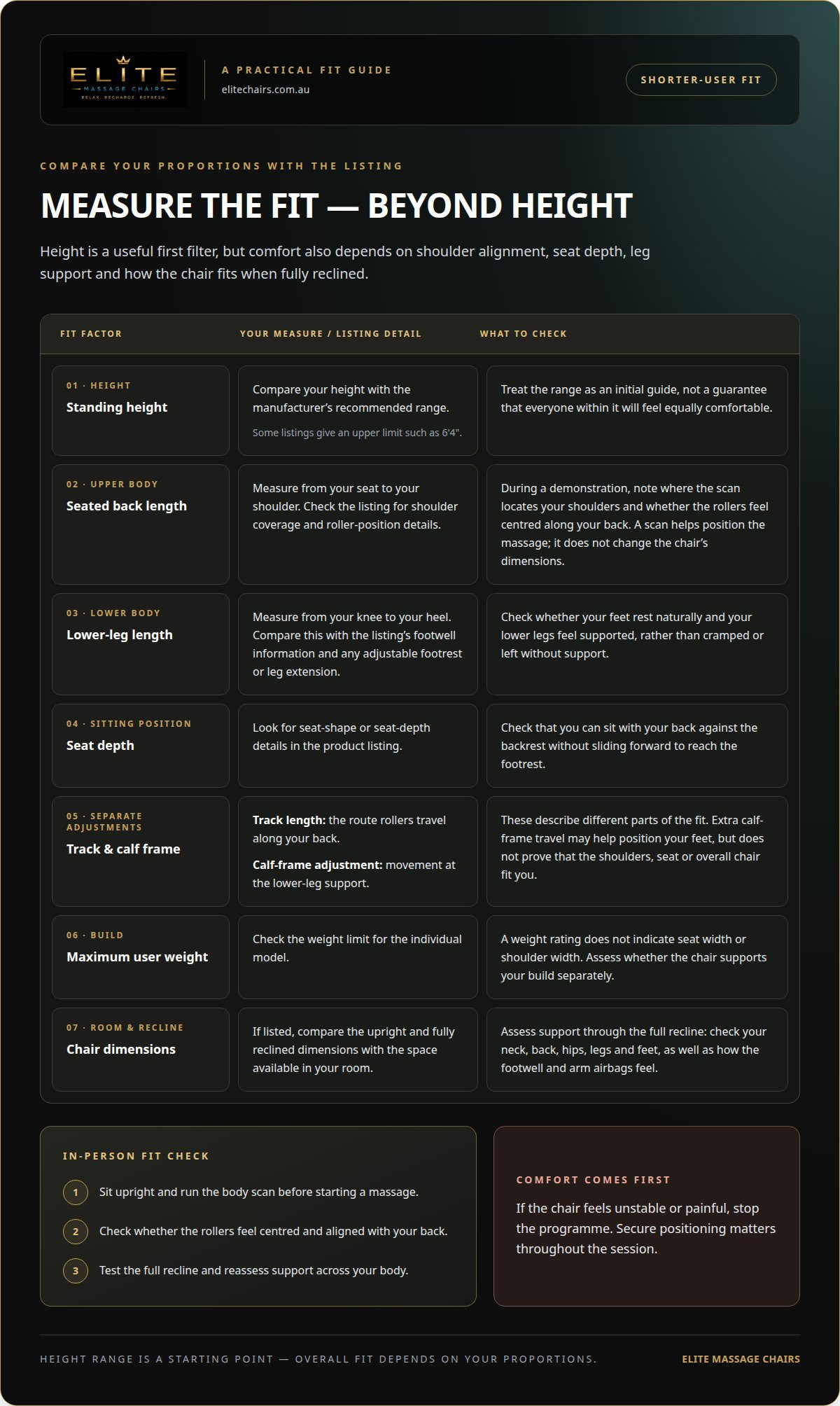
Use your measurements alongside the chair’s specifications, rather than relying on height alone. Record your standing height, seated back length from seat to shoulder, and lower-leg length from knee to heel. Compare these with the listing’s recommended height range, track details and footwell information. If the listing gives upright and fully reclined dimensions, compare both with the space available in your room.
Consider how your body would sit in the chair. A seat that’s too deep may make it difficult to keep your back against the backrest; a footwell that’s too long may leave your feet without natural support. Check whether the listing describes adjustable footrest positioning, shoulder coverage and arm placement. Maximum weight ratings don’t indicate seat or shoulder width, so they can’t tell you whether the chair will feel spacious.
A poorly fitting chair can leave shorter users with unsupported feet, awkward positioning or uncomfortable pressure from rollers and airbags. If the chair feels unstable or painful, stop the programme. Comfort and secure positioning matter throughout the session.
During a demonstration, sit upright and run the body-scanning function before starting a massage. Notice where the scan locates your shoulders, then check whether the rollers feel centred and aligned with your back. Rollers that sit too high, too low or off-centre can make the massage feel misplaced. A body scan helps locate your position, but it doesn’t change the chair’s physical fit.
Then test the full recline, not just the starting position. As the chair’s angle changes, check whether your neck, back, hips, legs and feet remain supported. Notice whether the footwell holds your lower legs without feeling cramped, and whether the airbags feel comfortable around your arms. Use any listed features as prompts for what to assess in person. A brief reset between programmes can help you reassess the fit, rather than judging it only by the first few moments.
4. Choosing a massage chair for shorter users
Choose based on how a chair’s adjustments suit your body, not its label alone. A model designed for smaller users may be worth considering, particularly if its backrest adjusts. Check the manufacturer’s height range, then see whether the mechanism positions the backrest and massage coverage comfortably for your proportions.
Before settling on a model, identify the fit points that matter most to you: back support, shoulder placement, arm position and footrest reach. Sit upright with your back against the chair, then check whether you can maintain that position throughout a full massage programme. If you need to slide forward or stretch your legs to reach the footwell, the fit may feel unnatural.
Test the chair before starting a programme. Notice where the backrest meets your shoulders and whether you can reach the controls while seated. Then try the reclined or zero-gravity position. Your neck, back, hips, legs and feet should feel supported as the chair changes angle. Follow the full recline, since a position that feels comfortable upright may feel different when reclined.
If people of different heights will share a chair, assess each person separately. One person’s fit doesn’t establish another’s, even if both fall within the listed range. Consider each user’s build and the adjustments they need, then compare those needs across the models you’re considering. The chair should suit the people who’ll use it, rather than relying on a general fit label.
Finally, check the model’s upright and reclined dimensions against the room. Wall-clearance requirements vary by model, so don’t assume one chair’s spacing applies to another. A considered choice brings together body fit, useful adjustments and practical placement, helping you focus on comfort as well as features. Explore massage chair options with these fit points in mind.
Elite Massage Chairs: Massage Chair Showroom Demos
Elite Massage Chairs offers showroom demonstrations so you can assess how a chair fits your body before choosing one. A demonstration is especially useful after comparing your measurements with a listing: you can experience the seat depth, shoulder placement and footrest support in person.
During the demonstration, sit upright, try the controls and test the chair through its recline. Notice whether your back stays comfortably against the backrest and your feet feel supported. If you’re considering a zero-gravity massage chair, try that position too, since your sense of fit may change as the chair reclines. Massage accessories are also available to purchase.
For a more informed choice, bring the fit points that matter most to you, such as roller alignment or leg support. To explore your options in person, contact Elite Massage Chairs.
Choose a chair that feels right for your routine
Choose with your everyday routine in mind. A chair is a considered addition to your home, so picture when you’re most likely to use it and what would help you feel at ease. For a massage chair for shorter users, the best choice isn’t simply the model with the most adjustments; it’s the one whose fit and feel work for you.
Give yourself permission to value ease over the number of features. A relaxing routine is personal, and the features worth prioritising are those that support your preferred pace, comfort and sense of calm. For busy households, creating that quiet downtime often means ensuring everyone has their own fun outlet—whether that’s parents recharging in a massage chair or children active outdoors on ride-on toys from Hoveroo. A massage chair should complement the time you set aside to unwind, not require you to adapt your habits around it.
If your shortlist still leaves you weighing preferences, a conversation centred on your needs can help you move towards a confident decision without rushing. Ask Elite Massage Chairs about fit.
Frequently Asked Questions
What makes a massage chair suitable for short people?
A suitable chair lets you sit back, reach the controls and feel supported without stretching or shifting forward. Imagine a shorter household member perching at the edge to reach the footrest: that position can change how the massage feels. A chair’s stated height range is a starting point; your seated posture and how its support meets your body matter too.
Does an advertised calf-frame extension prove the chair will fit my leg length?
No. A calf-frame extension adjusts lower-leg support, not the fit of the whole chair. It may bring the footrest closer while the seat still feels too deep, for example. Check what the extension moves, then consider your legs and seated posture together. The adjustment is useful only if your feet and lower legs feel comfortably supported in your usual sitting position.
How should you measure yourself against an exact Australian listing?
Record your height and seated measurements, then compare them with the specifications for the exact model. For example, note the distance from your seat to your shoulder and from your knee to your heel. Match those proportions to the listing’s user-height guidance, backrest and footrest details. Keep the model name with your notes so you don’t apply one chair’s dimensions to another.
What if the listing gives outside width but not seat or shoulder width?
The chair’s outside width measures its overall footprint, not the space available for your body. It can’t tell you how much room you’ll have at the seat or shoulders. Treat those as separate fit questions, particularly if the arm placement feels restrictive. A showroom demonstration lets you experience the interior space directly, rather than relying on the external measurement as a guide to comfort.
What room and access measurements should you check before ordering?
Compare the chair’s upright and reclined dimensions with its intended position, then consider the route into the room. Measure narrow doorways, hallways and tight turns, as well as the floor space around the chair. A model’s wall-clearance requirement applies to that model, not another. Allow for the chair’s movement when reclined so it can operate without obstructing nearby furniture or walkways.
Which fit questions should you ask before buying?
Ask how the model adjusts for shorter users, whether its recommended height range includes you, and how body scanning positions the rollers. Clarify the chair’s upright and fully reclined dimensions, including its wall-clearance needs. If others will use it too, ask how each person’s fit can be assessed. These focused questions help connect listing details with the comfort you need.


