

What if easing the strain of a long day at a desk came down to changing how your body meets gravity? The science of zero gravity posture isn’t about floating or living weightlessly. It’s about using a reclined position to redistribute support and encourage a more neutral posture.
If you’re sceptical of wellness claims, that’s reasonable. Persistent lower-back pressure, heavy legs or swelling deserve more than impressive-sounding marketing. The idea has roots in NASA’s observations of Neutral Body Posture during the Skylab missions, but a chair can’t remove gravity or guarantee a health outcome. Its value lies in how it supports your body and how comfortable the position feels to you.
In this guide, you’ll explore the engineering behind neutral posture, what spinal decompression can and can’t mean, and how recline may influence circulation, breathing and relaxation. You’ll also learn why individual adjustment matters, so you can assess the evidence with confidence and decide whether a zero gravity massage chair could support more restorative downtime. A showroom demonstration offers a practical way to experience the position for yourself.
Key Takeaways
- Learn how the science of zero gravity posture draws on NASA’s Neutral Body Posture research and informs ergonomic design on Earth.
- See how recline and individual adjustment can help reduce the strain associated with prolonged upright sitting, without assuming one position suits everyone.
- Understand how posture may influence circulation and breathing, and why wellness benefits should be considered thoughtfully rather than treated as guaranteed outcomes.
- Explore how zero gravity positioning works alongside mechanical massage rollers and 3D or 4D massage technology.
- Use a showroom demonstration to assess how a chair’s recline and massage feel for your body.
What is the Science of Zero Gravity Posture?
“Zero gravity” is a familiar name for a reclined position designed to distribute body weight more evenly. The idea draws on NASA’s observations of astronauts, but the phrase doesn’t mean gravity disappears on Earth. A supportive chair changes the angle of your body relative to gravity, aiming to reduce concentrated pressure and encourage a relaxed, balanced position.
The NASA Legacy in Modern Wellness
In microgravity, astronauts’ bodies naturally settle into a relaxed arrangement known as Neutral Body Posture (NBP). NASA studied this position to understand how the body could be supported in spacecraft, where ordinary standing and sitting postures don’t apply. This Neutral Body Posture offers a useful starting point for ergonomic design, not a one-size-fits-all prescription for health.
On Earth, gravity continually acts on the body, and prolonged static postures can feel tiring. A zero gravity chair can’t recreate space or remove gravitational forces. Instead, it uses a reclined, adjustable position to support the body. In practice, adjust the chair to your proportions and comfort rather than trying to hold a rigid “ideal” pose.
Anatomy of the 128-Degree Angle
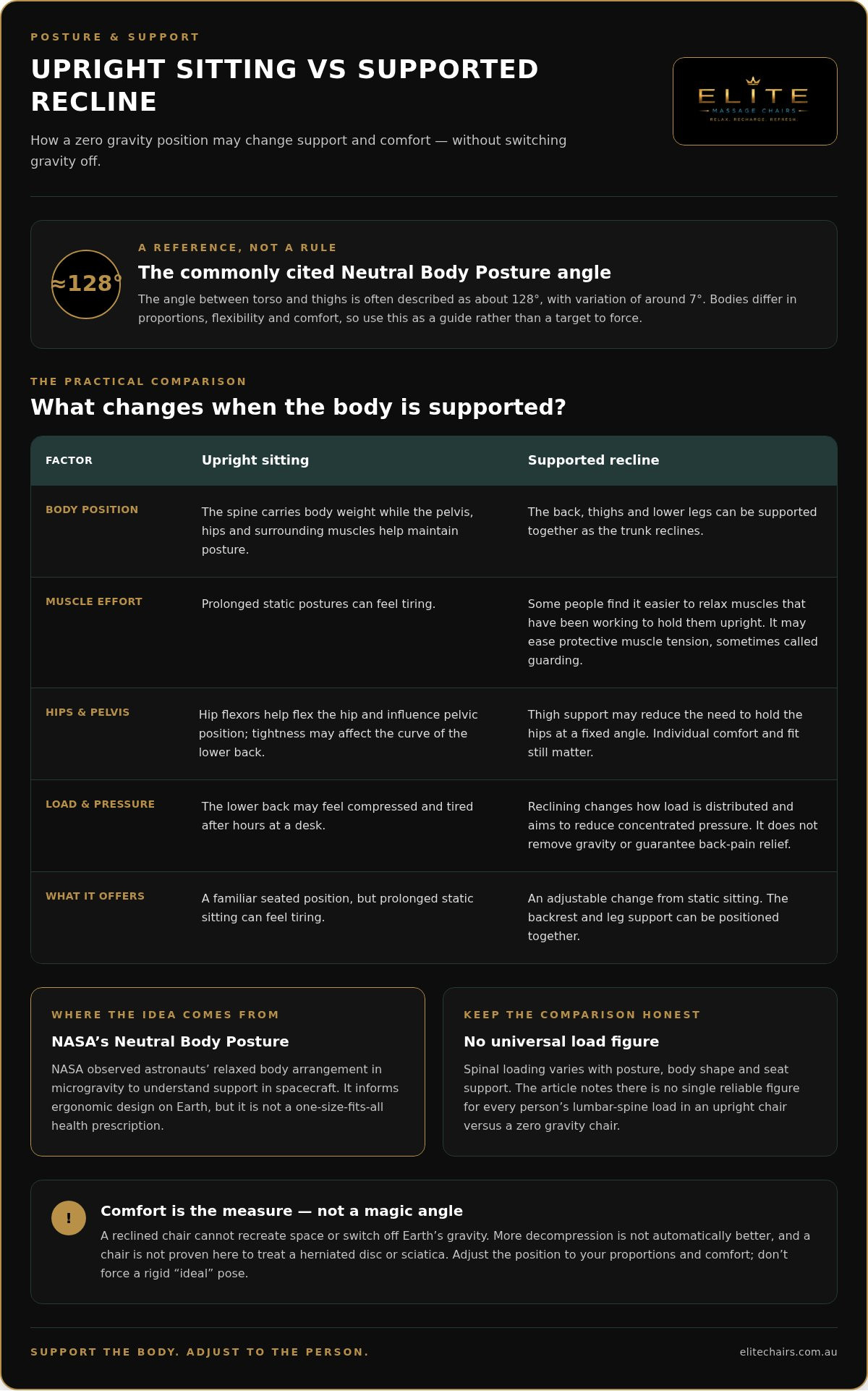
A commonly cited reference for NBP places the angle between the torso and thighs at about 128 degrees, with a variation of around 7 degrees. Treat this as a guide, not a magic number. People differ in flexibility, proportions and comfort. The right recline is the one that supports your body without forcing a joint into position.
Neutral posture is not simply a state where every muscle and tendon is at its shortest. The aim is relaxed alignment that reduces unnecessary muscular effort and avoids excessive strain. With the legs supported and the trunk reclined, some people experience a sense of lightness, as though their weight is more evenly carried by the chair. That sensation can feel restorative, even though the body remains under Earth’s gravity.
Claims that one precise angle minimises the heart’s workload should be treated cautiously. Posture alone doesn’t establish a guaranteed cardiovascular benefit. The practical takeaway is that adjustability matters. During a showroom demonstration, try the recline, notice where support feels comfortable and distinguish a good fit from a position that merely looks like a diagram.
Biomechanical Impact: Decompressing the Spine
Hours spent upright at a desk can leave the lower back feeling compressed and tired. The spine carries the body’s weight while the pelvis, hips and surrounding muscles help maintain posture. Reclining changes how that load is distributed, but it doesn’t switch gravity off or guarantee relief from back pain.
Gravity and the Musculoskeletal System
Spinal decompression is the reversal of gravitational loading on the vertebrae. In practice, loading varies with posture, body shape and how a seat supports the pelvis and legs. There isn’t one reliable figure for the load on every person’s lumbar spine in an upright chair compared with a zero gravity chair, so a precise comparison would be misleading.
With the back, thighs and lower legs supported, some people find it easier to relax muscles that have been working to hold them upright. This may ease protective muscle tension, sometimes called guarding, although persistent pain or tightness can have causes that posture alone won’t resolve.
The iliopsoas, a group of muscles connecting the lower spine and pelvis to the upper thigh, helps flex the hip and influences pelvic position. If hip flexors feel tight, the pelvis may tilt forwards, changing the curve of the lower back. A reclined position that supports the thighs can reduce the need to hold the hips at a fixed angle. Comfort and individual fit still matter.
The Science of Rehydration in Spinal Discs
Intervertebral discs sit between the vertebrae and help absorb load. During daily activity, they lose some fluid under compression; periods of reduced loading allow them to take up fluid again. This natural exchange supports disc structure, but it isn’t a quick repair process or proof that a chair can treat a herniated disc or sciatica.
Research on simulated microgravity has also found that disc swelling can reduce spinal flexibility and increase strain during bending. That’s a useful reminder: more decompression isn’t automatically better. A neutral, supported position is different from trying to stretch the spine as far as possible.
A zero gravity chair isn’t inherently more effective for disc health than lying flat on a mattress. Its practical distinction is adjustability: the backrest and leg support can be positioned together, which may feel more comfortable than a fixed surface for some people. For office workers, periods of supported recline can offer a change from static sitting, but they don’t replace movement or thoughtful desk ergonomics.
Posture can also interact with other body systems; this overview of posture and heart health discusses possible cardiovascular and respiratory connections. To judge how a reclined position feels for your own back and hips, try a zero gravity chair demonstration.
Cardiovascular and Respiratory Benefits of Neutral Posture
A supportive recline may change how comfortably your body rests, but it shouldn’t be mistaken for a treatment for poor circulation, swelling or high blood pressure. Potential benefits depend on your health, positioning and how long you remain still. Think of neutral posture as a way to support relaxation, not a substitute for medical care or regular movement.
Circulatory Efficiency and Heart Health
When the legs are raised, gravity can assist the return of blood through the veins towards the heart. Supporting the knees and lower legs may also reduce the sensation of heaviness after prolonged sitting. This doesn’t mean a chair lowers vascular resistance or reliably reduces the heart’s workload. Circulation is influenced by many factors, including movement, hydration and individual health.
The same caution applies to peripheral oedema, or swelling in the limbs. Leg elevation is commonly used to help manage fluid pooling, and a reclined chair can make that position comfortable. It doesn’t establish why swelling is present or treat its cause. Gentle movement also matters because contracting leg muscles helps move blood and lymph through the body. For people managing hypertension or circulation concerns, a zero gravity position may be a restful change of posture, not a replacement for clinical advice or prescribed treatment.
A 2022 study in the Journal of Healthcare Engineering reported that deviation from neutral trunk posture could negatively affect cardiovascular measures, including stroke volume and cardiac output. That finding points to a relationship between posture and the cardiovascular system, but it doesn’t prove that a zero gravity chair improves heart health.
Lung Expansion and Diaphragmatic Breathing
Breathing relies on the diaphragm moving down as the rib cage expands. A slumped position can restrict comfortable movement of the chest and abdomen. Reclining with the back and legs supported may make it easier for some people to take a relaxed, fuller breath. The commonly cited 128-degree torso-to-thigh position is a reference, not a proven respiratory prescription, and the best recline varies between individuals.
A comfortable neutral posture may allow the rib cage and diaphragm to move more freely and support fuller breaths, but this doesn’t guarantee an increase in blood oxygen saturation. Oxygen levels depend on lung function and overall health, not posture alone.
Comfortable breathing and reduced muscular effort can support a more restful recovery period after a busy day or physical activity. However, deeper breathing doesn’t establish faster muscle repair, and a chair shouldn’t be viewed as a recovery treatment. The science of zero gravity posture is best understood as supportive positioning: notice how your breathing feels, adjust until your body is comfortable and break up long periods of sitting with movement.
Zero Gravity in Practice: Maximising Therapeutic Outcomes
A reclined position can make a massage feel different, but the experience depends on more than the chair angle. Zero gravity positioning supports the body while massage rollers move along it. This combination may help you settle into a session without needing to brace or hold yourself upright, but it doesn’t guarantee deeper treatment or a particular therapeutic result.
Enhancing Massage Depth and Precision
With the back and legs supported, your body’s weight is distributed across the chair rather than concentrated on one contact point. This can create a steady surface for the rollers to work against, although pressure and comfort still depend on your build, the chair’s adjustment and the massage settings. 3D and 4D massage technology can offer more dimensional movement, but zero gravity isn’t a technical requirement for a massage mechanism to operate or a guarantee of maximum depth.
Body-scanning features can help a chair map body position and align massage contact points. Reclining may provide a consistent setup, but scanning accuracy depends on the technology and how well the chair fits you. A zero gravity vs traditional massage chair comparison can help you understand how recline changes the feel and support of a session.
Heat may add a soothing sensation and help you relax into the massage. It shouldn’t be described as driving rollers deeper into tissue or as a proven way to improve recovery. If heat is available, use a comfortable setting and follow the chair’s guidance.
Building a Comfortable Recovery Routine
After exercise, gentle massage may feel relaxing, but claims that a chair clears lactic acid or speeds muscle repair go beyond what positioning alone can establish. For a broader view of how massage may fit into an athlete’s recovery habits, see this guide to a massage chair for athletes in Australia.
There’s no universal session length that suits everyone or guarantees a particular nervous-system response. Start with a comfortable setting, follow the chair’s instructions and stop if you feel pain, numbness, dizziness or unusual discomfort. A shorter, gentle session can be a sensible first trial, especially if you’re new to massage chairs.
The science of zero gravity posture is most useful when it informs a position that feels supportive in practice. Experience a zero gravity massage chair demonstration to explore the recline, roller pressure and available settings for your body.
Investing in Science-Backed Wellness at Elite Massage Chairs
A zero gravity massage chair is a considered addition to your home, so base your decision on how it fits your body and routine, not on impressive-sounding claims alone. The science of zero gravity posture offers a useful framework: look for comfortable support, an adjustable recline and massage settings that suit you. These features can shape a restorative experience, but they don’t guarantee a particular health outcome.
The Showroom Experience: Testing the Theory
A showroom demonstration lets you experience the chair rather than relying on descriptions. As you try different recline positions, notice whether your back, hips, thighs and lower legs feel supported and whether the massage pressure is comfortable. The often-cited 128-degree angle can be a point of reference, not a target every body must match. Your own relaxed, well-supported position is what matters.
Compare how the chair feels upright and reclined, and take time to explore the adjustments. This hands-on trial can help you judge the transition from familiar seating to a more evenly supported posture. For practical pointers, read this guide to a massage chair demo in Australia.
Securing Your Home Sanctuary
Assess the chair as a complete piece of wellness technology. Consider whether the recline feels natural, the controls are straightforward to use and the massage functions suit your preferences. Elite Massage Chairs specialises in premium massage chairs and wellness solutions, including zero gravity massage chairs and massage accessories. This overview of a therapeutic massage chair offers more context on what to consider for home use.
A chair’s long-term value depends on how well it fits into your life. Think about whether you’ll use it as part of a regular wind-down routine and whether its settings remain comfortable as your needs change. A showroom trial can help you make that judgement based on personal experience.
Elite Massage Chairs sells zero gravity massage chairs and massage accessories online and in-store. You can book a free showroom demonstration to experience the chairs firsthand, and Humm financing options are available. If you’re considering a premium chair, try the recline and massage settings in person, then think about how comfortably they could fit into your home routine.
Bring a More Considered Approach to Rest
The science of zero gravity posture offers a useful way to think about support and relaxation, not a promise of weightlessness or a cure for back, circulation or breathing concerns. A well-adjusted recline can distribute support across the body, while individual comfort remains the best guide to finding a suitable position.
Keep two ideas in mind: neutral posture is a reference rather than one perfect angle for everyone, and massage-chair features work best when they feel comfortable and fit your needs. A showroom demonstration lets you experience the recline and massage settings firsthand, turning the theory into a practical trial for your body.
Elite Massage Chairs offers premium zero gravity solutions, with Humm financing options available. Take the next step at your own pace: book a free zero gravity massage chair demonstration and explore what a more restorative moment at home could feel like. Finding a comfortable fit can be a practical start to a more relaxing daily routine.
Frequently Asked Questions
What exactly is the zero gravity position in a massage chair?
It’s a reclined position that supports the back and legs to distribute body weight more evenly, rather than making you weightless. The backrest and leg rest move into a coordinated angle, often with the feet raised, so the body can settle into a relaxed posture. The science of zero gravity posture draws on Neutral Body Posture research, but comfort and fit vary between people.
Is zero gravity posture safe for people with pre-existing heart conditions?
It may be comfortable for some people, but safety depends on the individual condition and the chair’s position and massage settings. If you have a heart condition, circulation concerns or have been advised to limit recline or leg elevation, speak with your healthcare professional before using a massage chair. Stop if you feel unwell, dizzy, short of breath or unusually uncomfortable, and follow the chair’s instructions.
How does zero gravity help with lower back pain specifically?
A supported recline can change how body weight is distributed and may reduce the effort needed to maintain an upright posture, which some people find more comfortable for the lower back. It isn’t a treatment for the cause of pain, and it won’t reliably resolve sciatica or a herniated disc. Persistent, worsening or new back pain deserves assessment by a qualified health professional.
Can I sleep in a zero gravity massage chair overnight?
A massage chair is designed for massage and reclined relaxation, not necessarily as an overnight bed. Don’t assume that staying in one position for hours is suitable, even if the chair feels comfortable during a shorter session. Follow the manufacturer’s instructions for use and session settings. If you’re considering sleeping reclined because of a health concern, discuss it with your healthcare professional first.
What is the difference between a standard recliner and a zero gravity chair?
A standard recliner generally leans the back while raising the legs, but its movement and support vary by design. A zero gravity chair is intended to coordinate the backrest and leg position to create a more balanced, reclined posture. Some models also include massage functions. The label alone doesn’t guarantee a particular angle or fit, so assess how comfortably the chair supports your body.
Does the zero gravity position help with snoring or sleep apnoea?
There isn’t enough here to treat a zero gravity massage chair as a proven solution for snoring or sleep apnoea. Research on an inclined bed cannot automatically be applied to a massage chair, and sleep apnoea needs appropriate assessment and treatment. If you snore heavily, wake gasping or feel very tired during the day, speak with a healthcare professional rather than relying on chair positioning.
How many degrees is a true zero gravity position?
About 128 degrees between the torso and thighs is a commonly cited reference for NASA’s Neutral Body Posture, with roughly 7 degrees of variation. It isn’t a universal target or a standard that every chair must meet. People differ in proportions and flexibility, so a comfortable, well-supported recline matters more than matching one exact measurement.
Do I need a special type of massage chair to achieve neutral body posture?
No single massage-chair type guarantees Neutral Body Posture. Look for a design that lets the back and leg support recline together and feels comfortable for your proportions. Massage features are an additional function, not a requirement for a neutral position. A showroom demonstration can help you experience the chair’s adjustments and decide whether its support feels suitable before choosing a model.


