

A 4D massage roller isn’t simply a stronger 3D roller. If you’re asking what a 3D vs 4D massage roller is, the key difference is that 3D rollers move up and down, side to side and further into the back, while 4D adds variable speed, rhythm and intensity controls. The 4D label is industry shorthand for these changes in roller speed, not an actual fourth dimension.
It’s reasonable to wonder whether those extra controls justify paying more. A 3D system can already deliver targeted pressure, while pressure from either type depends on the chair and its settings, so 4D isn’t automatically the better fit for everyone.
This comparison explains how the rollers differ in movement, depth, speed and rhythm, and what those differences may feel like during a session. You’ll also find a practical way to weigh the added control against your preferences, so you can choose the massage experience that feels right for you.
Key Takeaways
- Compare roller depth as well as movement: 3D systems can extend 2 to 5 inches into the back, making adjustability a useful factor when choosing a massage feel.
- Consider whether changes in pace and rhythm matter to you during a longer session, rather than assuming extra controls mean stronger pressure.
- Use the 2D flat-plane movement as a baseline to understand what added depth and movement can bring to a massage experience.
- Match the chair’s roller reach and track to your body and the areas you want massaged for a more considered choice.
What's the difference between a 3D and 4D massage chair?
A 3D system adds adjustable roller depth, while 4D adds control over speed, rhythm and intensity. The difference is how the massage chair delivers pressure, not a guarantee of stronger treatment.
3D roller depth adjustment
3D rollers move up and down, side to side and further out into the back. They can protrude 2 to 5 inches, letting you adjust how deeply they press against your muscles. A shallower setting may feel gentler; greater extension can create more focused pressure and mimic aspects of deep tissue massage. This depth control distinguishes 3D from a flat-plane 2D system.
4D sensing and real-time adjustments
4D adds variable speed, rhythm and intensity controls to 3D roller movement. That can make the massage pace more varied, but it doesn’t automatically increase pressure; the model and settings matter. 5D is a separate label: these chairs use sensors to adjust massage according to body shape, weight and movement. So 4D describes roller pacing, while 5D sensing responds to the user.
Which massage roller is better for back and neck pain? Neither type is universally better for pain. A 3D chair offers adjustable depth, while 4D adds pacing controls; comfort and pressure preferences help guide the choice.
How much do 3D and 4D massage rollers cost in Australia? The price depends on the chair and its features, including roller controls and track design. Compare the full chair specifications rather than the 3D or 4D label alone.
What are the risks or contraindications of using a massage roller? Follow the massage chair manufacturer’s instructions. If you have medical concerns, consult a healthcare professional before using a massage roller.
Which Australian brands sell 3D or 4D massage rollers? Australian retailers sell massage chairs with different roller technologies. Compare each chair’s specifications to see whether it offers depth adjustment, variable pacing or 5D sensing.
What should I check before buying a 3D or 4D massage roller? Check the depth adjustment, available speed and rhythm controls, and how the chair positions its rollers. Match these features to the massage areas and pressure you prefer.
| Roller type | Movement or response | Control distinction |
|---|---|---|
| 2D | Back and forth, up and down on a flat plane | No added depth movement |
| 3D | Moves up, down, side to side and further into the back | Adjustable depth |
| 4D | Builds on 3D movement | Variable speed, rhythm and intensity |
| 5D | Uses sensors to respond to the user | Adjusts for body shape, weight and movement |
Choose 3D for depth adjustment, 4D for varied pacing, or 5D if sensor-led responses are a priority.
4D speed, rhythm and intensity controls
4D rollers add changing speed, rhythm and intensity to the movements available in a 3D system. Instead of keeping one pace throughout a massage, the rollers can vary their timing, creating a more fluid sequence. The term “4D” refers to variable roller speed, not a literal fourth dimension. The practical difference is how the massage feels as its pace changes.
Some 3D chairs let you adjust roller speed manually during a session. With 4D chairs, speed changes can be programmed to happen automatically, so the massage may move between slower and quicker passes without you changing settings. The roller can also speed up or slow down to focus on tense muscles. This can make the rhythm feel less repetitive across a 20 to 30 minute session.
Think of a steady pace as one consistent beat and a varied rhythm as a sequence that changes tempo. A gentler, slower pass may feel more comfortable in a sensitive area, while a quicker rhythm can create a more active sensation. These are differences in pacing, not promises of a particular therapeutic result.
- Speed: how quickly the rollers travel during a massage pass.
- Rhythm: how the pace changes or repeats across the session.
- Intensity: the overall feel of the massage, shaped by the chair’s settings and roller pressure.
More variation doesn’t automatically mean stronger pressure. A 4D chair may feel smoother or more expressive, but pressure still depends on the model and settings. If you prefer a consistent sensation, a 3D chair with manual speed adjustment may suit you; if you value changing pace, automatic 4D variation may be more appealing.
Compare the experience rather than relying on the label alone. A massage chair showroom demonstration offers a chance to notice how a chair’s pace and pressure feel in person.
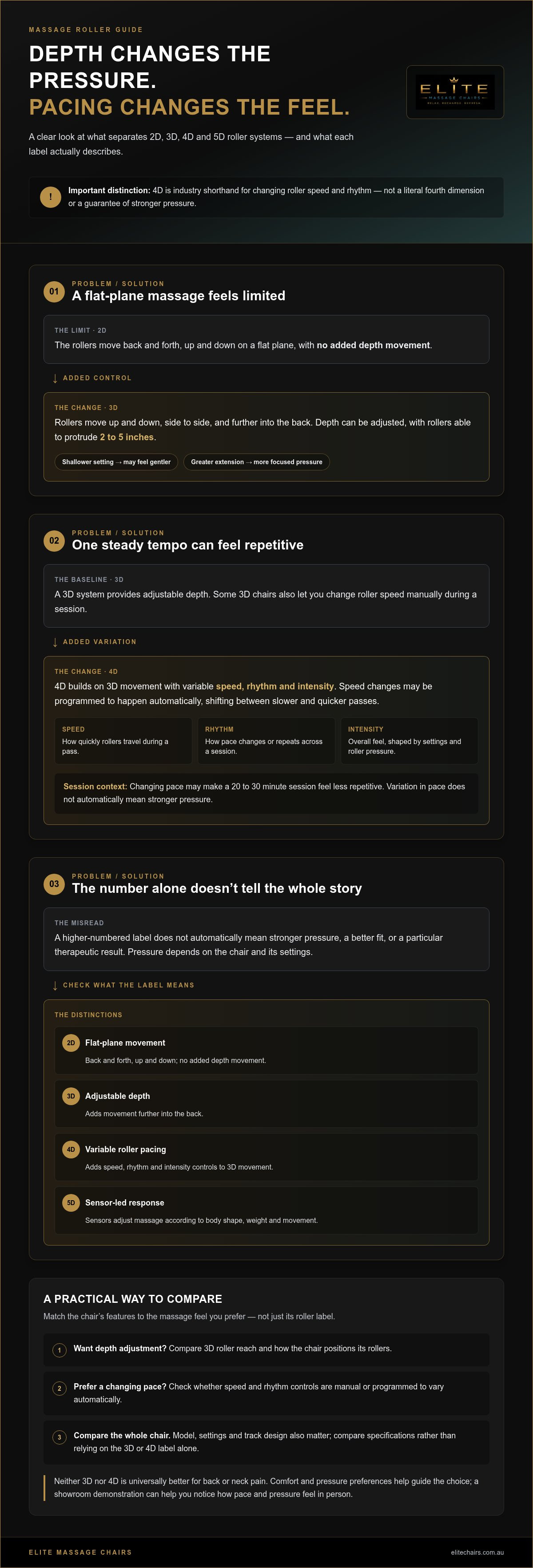
Differences between 3D and 4D massage rollers
Across 2D, 3D and 4D chairs, the key distinction is movement: 3D adds depth, while 4D adds variation to the massage experience.
3D roller experiences
A 3D roller works across three directions: up and down, side to side, and further into the back. That extra dimension lets it apply deeper, targeted pressure than a 2D roller moving on a flat plane. For example, someone seeking a focused sensation around the shoulders may value depth adjustment more than changing pace. The result can feel direct and consistent, supporting relaxation without the added rhythm variation associated with 4D.
4D roller experiences
A 4D roller builds on 3D movement by varying speed and rhythm, creating a massage that can feel more immersive. The rollers may speed up or slow down as they work, so the sensation changes rather than staying at one tempo. That variation is the main experiential difference, not an automatic increase in depth or pressure. Track design also matters: an SL-track can extend from the neck through the back and glutes.
Massage modes and intensity
Do 4D massage rollers have more massage modes or adjustable intensity than 3D rollers? Not necessarily: 4D refers to variable speed, rhythm and intensity controls, but the available modes depend on the chair. A 3D model may still offer adjustable depth and strong, targeted pressure. Compare the controls listed for each chair, rather than assuming the 4D label guarantees more programs.
For a practical comparison, consider three points: whether you want adjustable depth, whether changing pace matters, and which areas the track reaches. For example, prioritise 3D depth if you prefer a steady massage with targeted pressure; consider 4D if you want the rhythm to vary. Check track coverage separately, especially if you want massage to extend towards the glutes. The best match depends on the experience you value, not the dimension number alone.
How 2D rollers move and massage
A 2D massage roller moves back and forth and up and down on a flat plane. Traditional chair mechanisms place two fixed rods behind the chair, guiding the rollers along the back without extending them further into the body. The motion can create a steady, repeating massage pattern, but it doesn’t add the depth adjustment associated with 3D movement.
Early massage chairs used 1D technology, with rollers travelling up and down the back. During the past 10 years, almost all massage chairs have been equipped with 2D rollers. That step added back-and-forth movement across the same flat plane, giving the rollers another direction of travel without the extra reach of a 3D system.
How does a 4D massage roller work? It builds on 3D roller movement by varying speed, rhythm and intensity. The rollers can speed up or slow down automatically, changing the pace of the massage rather than following one steady tempo.
Here’s the movement distinction: 2D rollers travel across a flat plane; 3D rollers add side-to-side movement and extend further into the back; 4D adds variable pacing to those 3D capabilities. The labels describe roller movement and control, not a guaranteed level of relief or deep tissue massage. Tissue pressure and the overall sensation depend on the chair’s design and settings.
- 2D: back-and-forth and up-and-down travel on a flat plane.
- 3D: additional side-to-side travel and adjustable depth.
- 4D: 3D movement with changing speed, rhythm and intensity.
Use this sequence to compare chairs: identify the roller directions, look for depth adjustment, then consider whether automatic pace changes suit your preferred massage experience. 4D massage chairs may feel more varied, but the “ultimate” choice depends on whether you value that variation over a simpler, consistent pattern.
To compare roller movement and rhythm in person, book a massage chair showroom demonstration and experience how different settings feel.
Elite Massage Chairs: Zero Gravity Massage Chairs
Elite Massage Chairs offers zero-gravity massage chairs for people considering a chair for home relaxation. Once you understand the difference between roller depth and changing pace, match those features to the feel and support you prefer. Book a showroom demonstration to experience a chair firsthand and assess its comfort before deciding. Massage accessories are also available to complement your setup. A demonstration is especially useful when weighing a steady massage against a more varied rhythm, as descriptions alone cannot convey how a chair feels in use. Explore the options with Elite Massage Chairs.
Choose the massage experience that suits your routine
The right choice is the one you’ll feel comfortable using as part of your regular routine. Before deciding, consider what matters most in everyday use: a consistent massage, more variation in pace, or the way the chair supports your preferred sitting position. Understanding what a 3D vs 4D massage roller means gives you a clearer starting point, but your own comfort should guide the final choice.
If you’re still weighing up the options, consider how different massage chair features fit your needs. Elite Massage Chairs offers zero-gravity massage chairs, massage accessories and showroom demonstrations to help you plan a more restorative space at home.
Contact Elite Massage Chairs to discuss your next step, and move towards a massage experience that feels right for you.
Frequently Asked Questions
3D vs 4D: is 4D worth the extra money?
If you’re asking, “what is a 3D vs 4D massage roller?”, the practical difference is whether variable pacing matters enough to justify the added cost. If you prefer a predictable massage and mainly want depth adjustment, 3D may suit your priorities. Compare each chair’s controls and overall design rather than paying more for a label alone. Consider whether you’d use the added variation regularly.
Does 4D mean the massage is always stronger than 3D?
No. A 4D massage isn’t automatically stronger than a 3D massage; pressure depends on the chair model and its settings. For example, a 3D chair set to deeper pressure may feel firmer than a 4D chair set gently. Treat speed variation and pressure as separate considerations, and compare how each chair lets you adjust the sensation to suit your comfort.
What makes 2D vs 3D vs 4D different?
The labels describe different capabilities, not a simple ranking of massage quality. A 2D chair uses rollers travelling across a flat plane; 3D adds adjustable depth, while 4D adds changing pace to 3D movement. For a practical comparison, look at the movement and controls listed for each chair. Then consider whether you want depth adjustment, varied rhythm, or both.
Which should you choose?
To answer “what is a 3D vs 4D massage roller?” for your own needs, focus on the sensation and controls you’ll use. If adjusting roller depth matters most, compare 3D chairs and their settings. If you enjoy a massage that changes tempo, explore 4D models and their pace controls. Check the chair’s fit and features against your preferences rather than choosing by its number.
Which is better for athletes or very active people, 3D or 4D?
Neither type is automatically better for athletes or active people. Someone who prefers targeted, adjustable pressure may favour a 3D chair, while a person who enjoys changing tempo may prefer 4D. After a training day, consider whether a steady sensation or varied pacing feels more comfortable. Massage chairs are wellness products, not substitutes for medical or rehabilitative care.
How does a 3D massage roller work?
A 3D roller moves in several directions and extends towards the back, allowing its contact depth to be adjusted. That adjustment changes how firmly the rollers meet the body, so the same chair can provide a gentler or more direct sensation. If you’re trying a 3D chair, begin with a comfortable setting and adjust gradually, following the manufacturer’s instructions.


