

A massage chair can suit a small apartment when its footprint, delivery route and reclined position work with the room. Many compact models are about 75–85 cm wide, while wall-hugging designs can need only 5–15 cm of clearance behind them. For a massage chair for small apartments in Australia, the fit depends on more than the chair’s width: doorways, hallways and the space you need to move around it matter too.
It’s understandable to worry that a massage chair for a small apartment in Australia could crowd your living area or arrive at the front door but not fit inside. Choosing the smallest model isn’t automatically the answer; a well-placed chair with space-saving recline may make better use of your home.
In this guide, you’ll learn how to compare compact and full-size chairs, measure the delivery route, assess the space needed to recline and choose a practical spot in your apartment. The aim is to help you picture the chair in your space before deciding.
Key Takeaways
- Compare comfort features such as body scanning and zero-gravity positioning alongside the chair’s footprint, rather than choosing by size alone.
- Map the full delivery route, including internal doors, stairs and lifts, before settling on a model.
- Consider how the chair moves as it reclines, and compare its upright and reclined dimensions with your available floor space.
- Look for a spot that supports relaxing without disrupting everyday movement, such as a living-room corner or multipurpose area.
1. Compact vs Full-Size: What's the Trade-Off?
Compact chairs suit apartments when their width, recline and user fit match the room. Many measure about 75–85 cm wide, while chairs wider than 90 cm can feel bulky in smaller spaces. Treat width as a starting point, then consider how the chair functions and feels. The best compact massage chair is the one that fits your space and your body while providing the massage features you value.
Look beyond the footprint. Some compact chairs offer an L-track that follows the body from the neck to the glutes, while body-scanning systems map your shape before a massage begins. Zero-gravity positioning elevates your legs above your heart to reduce spinal pressure. These features can make a smaller chair more capable, but compare their practical value with the space they require. Some compact designs also include lumbar heat, which can add warmth during a session.
Full-size chairs may have a broader design, but that doesn’t automatically make them a better choice. An ultra-compact model can save floor space, yet the smallest option may not provide the fit or features you want. Consider how the chair supports your body and whether its controls and massage coverage suit your routine. A massage chair for a small apartment in Australia should balance usable comfort with a footprint that works in the room.
Compact massage chair prices in Australia vary by model and features, so there isn’t one representative cost. Compare the design and functions included rather than choosing by price alone. Weight limits and user-height ranges also vary between chairs. Match each model’s stated maximum user weight and height range to the person using it; those specifications affect fit and massage alignment. A body scan can map body shape, but it doesn’t replace choosing a chair suited to the user.
2. Measuring delivery access and installation space
A chair can fit its intended spot yet fail to pass through the apartment entrance. Measure the full route from the building entrance to the room, including doorways, hallways, stairwells, interior doors and lifts. The narrowest point matters most, especially if the route includes a turn or tight landing. Record clear widths with doors open, and note anything that reduces the passage, such as a handrail or door handle.
For a space-saving chair delivered boxed or disassembled, allow at least 75 cm of doorway width. That figure is a useful starting point, not a substitute for measuring the actual delivery route. A hallway may be wide enough but still have a corner that limits turning space. Measure the approach to each turn and compare it with the chair’s delivery dimensions and the shape of its packaging.
- Measure each doorway at its narrowest clear point, then record the hallway width and ceiling height along the route.
- Check stairwells, landings and lift interiors, including the space needed to turn the chair or package.
- Measure the intended room position and allow at least 30 cm of walking space on each side of the chair.
At the destination, separate the chair’s footprint from the room needed to use it. A chair may fit between a sofa and wall while leaving too little space to walk comfortably. Sketch the room, mark the chair’s width and depth, then draw the walking clearance around both sides. Include nearby furniture, power points and the route to the chair, so everyday movement remains practical.
Keep one measurement list for the entry, route and final position. Compare it with the chair’s delivery and assembled dimensions before deciding. For a closer look at possible options, browse massage chair choices alongside your measurements.
3. What is wall-hugging technology?
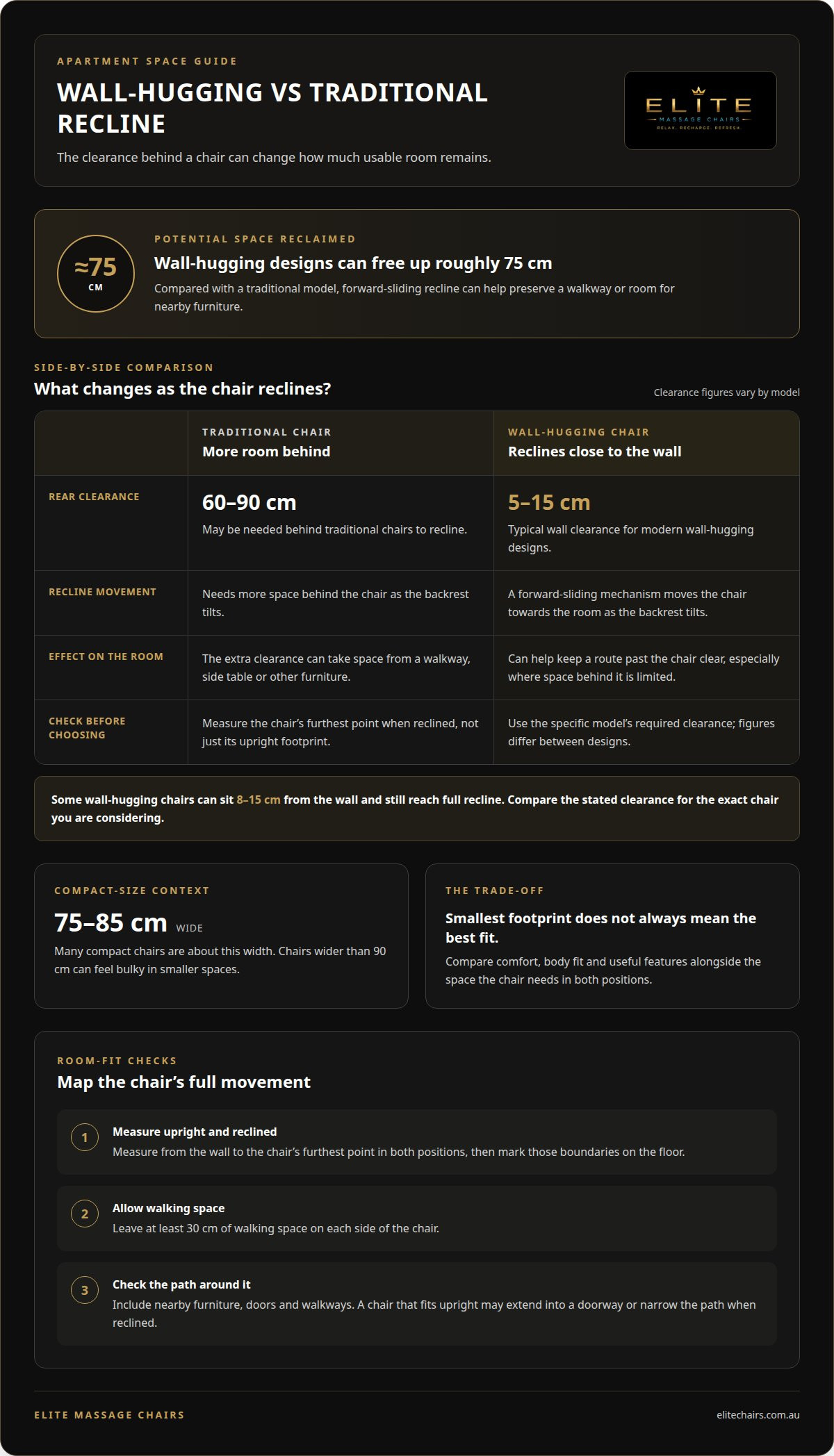
Wall-hugging technology lets a massage chair recline while remaining close to the wall. A forward-sliding mechanism moves the chair towards the room as its backrest tilts. This reduces the space needed behind the chair compared with traditional designs. In small Australian homes, traditional chairs may need 60–90 cm of rear clearance to recline. That extra space can take away room for a walkway, side table or another piece of furniture.
Yes, space-saving massage chairs are available, including wall-hugging designs that recline close to a wall. Some can sit 8–15 cm from the wall and still reach full recline. Modern wall-hugging designs typically need 5–15 cm of wall clearance. These measurements differ, so use the specific chair’s required clearance when planning its position. The key benefit is the forward movement, not a folding frame.
That movement can reclaim roughly 75 cm of usable space compared with a traditional model. In a lounge where a chair would otherwise block access behind it, that difference can help preserve a clear route past the chair. A slightly larger wall-hugging chair may therefore use a small room more efficiently than an ultra-compact model. The overall footprint alone won’t show how much floor space remains during a massage.
Compare the chair’s dimensions in both upright and reclined positions before deciding. Measure from the wall to its furthest point in each position, then mark those boundaries on the floor. Include nearby furniture and walking routes in your layout. A chair that fits upright may extend into a doorway or narrow the path when reclined. A poor fit can limit movement and stop the chair from reclining fully. For example, a chair beside a sofa needs room to recline without obstructing access to the seating.
4. Massage-chair placement in small homes
A corner can work well when the chair’s full recline stays clear of doors and walkways. In a living room, place it beside a wall rather than across the route between the sofa and kitchen. A home office, larger bedroom or multipurpose wellness area can also suit a massage chair. The best location is one that leaves everyday movement comfortable.
Delivery fees and arrangements can vary, so compare the details provided when buying a massage chair in Australia. Consider how the chair will travel through apartment corridors, stairs or a lift, and measure the route before choosing a delivery option.
Power, sound and flooring also affect where a chair feels practical. Position it near a suitable power point, with the cord routed clear of foot traffic. Massage mechanisms can make operating sounds, so consider whether a shared wall borders a neighbour’s bedroom. On timber or tiled floors, a protective mat can help separate the chair’s base from the surface. Keep the mat flat, so it doesn’t create a trip edge.
Electricity use depends on the chair’s rated power and how long each session runs. For an estimate, use the model’s power information alongside your expected session time. A longer program draws power for longer than a shorter one; actual consumption depends on the chair’s specifications and use.
Warranty, returns and repair arrangements vary among Australian massage-chair brands. Read the written terms for warranty coverage, exclusions, return conditions and the process for arranging a repair. These details matter after delivery, particularly if a chair needs to be moved or serviced within an apartment.
Before choosing a spot, mark the chair’s outline and recline area on the floor. Then walk past the marked space from the entry to the kitchen, bedroom and balcony. A chair in a living-room corner may preserve the main walkway, while the same chair beside a narrow doorway could obstruct access. Test the proposed placement against daily routes, not just the empty room.
Elite Massage Chairs: Zero Gravity Massage Chairs
Elite Massage Chairs offers zero-gravity massage chairs for shoppers comparing comfort and apartment fit. The chairs’ zero-gravity technology simulates weightlessness and relieves spinal pressure, while smart massage technology contours to the body. Book a showroom demonstration to experience a chair before choosing. Bring your room measurements and consider where it will sit, how it will recline and whether its shape suits your layout. That makes it easier to weigh the chair’s feel against the practical limits of your home.
Massage accessories are also available to complement your setup. Explore the options at elitechairs.com.au or book a showroom demonstration to experience a massage chair in person.
Make room for a more restorative routine
Give your massage chair a purpose beyond simply filling a corner. It should support a quiet pause without making the room feel organised around furniture. Picture an ordinary evening: where you’ll settle, what you’d like within reach and how the space feels while the chair is in use. That perspective turns the decision into more than a floor-plan exercise.
Choosing a massage chair for a small apartment in Australia means balancing comfort with the way you live at home. Your preferred routine, the room’s atmosphere and the space you want to preserve all shape what feels right. Imagine using the chair as part of everyday life, not just seeing it in a showroom or on a screen.
When you’re ready to explore your next step, contact Elite Massage Chairs. A considered choice can help make a little room feel like a welcome place to unwind.
Frequently Asked Questions
Are massage chairs suitable for apartments?
Yes, a massage chair can suit an apartment if it fits the room and your daily routine. Consider whether it blocks access to a balcony, wardrobe or kitchen, and whether you can use it without shifting other furniture. For example, a spare bedroom may work better than a living room that doubles as a walkway. Consider your neighbours and flooring, too.
Are smaller massage chairs less effective?
Not necessarily. A smaller frame alone doesn’t determine how well a chair suits you; body fit, massage coverage and the settings you’ll use matter. If possible, try the chair and notice whether it reaches the areas you want massaged. Someone seeking a simple relaxation routine may value different features from someone who wants broader coverage.
Compact vs Full-Size: What's the Trade-Off?
The trade-off is often between conserving room and choosing a chair whose proportions and features suit your preferences. A compact model may integrate more easily into a shared space, while a full-size chair may suit someone who prioritises a larger design. Compare how the chair feels and its massage coverage, not just its label. Let the regular user’s needs guide the decision.
How much room do I need around a massage chair?
Allow enough room to enter and leave the chair comfortably, reach its controls and move around it without squeezing past furniture. Picture the chair in use, not just standing upright: a nearby coffee table or open cupboard can interfere with access. Trace the path from the apartment entrance to the chair, then from the chair to the room’s main walkway.
What is wall-hugging technology?
Wall-hugging technology lets a chair recline through a forward-moving mechanism rather than needing the same rearward movement as a traditional design. This can make positioning near a wall more practical. It doesn’t mean every model folds or needs identical clearance. Compare the space behind the chair with the space it occupies as the backrest tilts.
What are the dimensions and space requirements of small massage chairs?
Dimensions vary by model, so use the individual chair’s measurements rather than assuming all compact designs share a standard size. Compare its width and depth with the available space, then account for its position during use. Also consider the delivery route: an apartment’s entry door may be narrower than the room where you plan to place the chair.


