

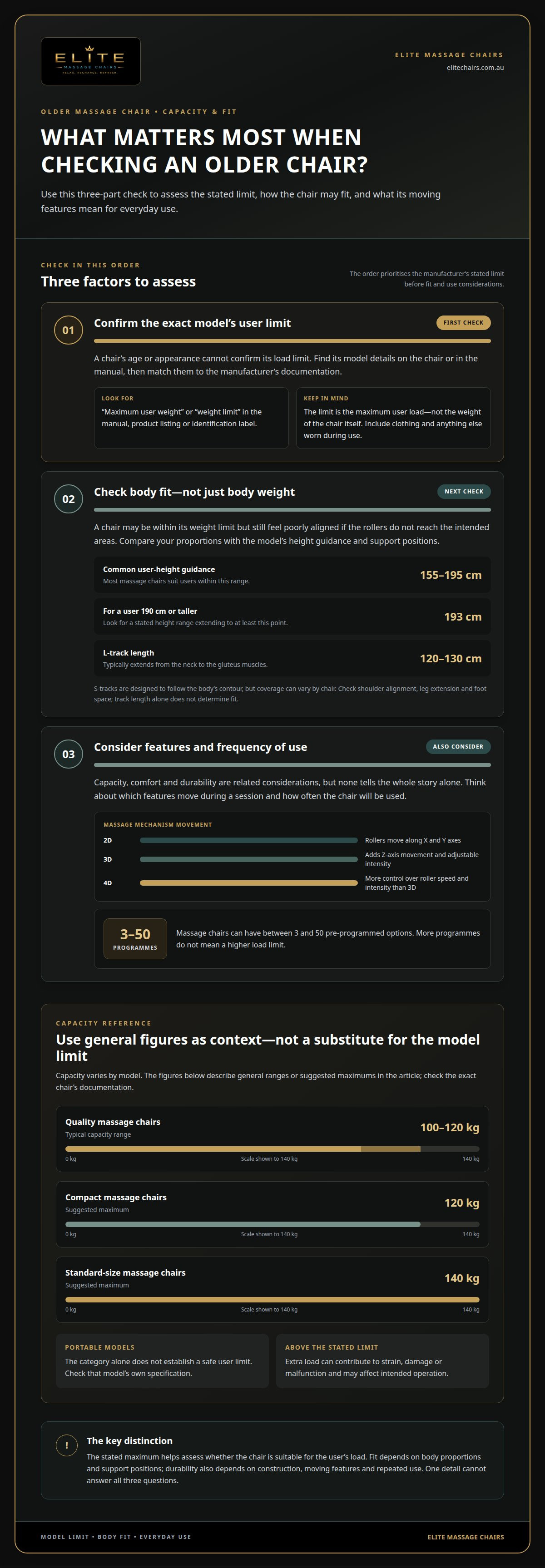
An older massage chair’s age doesn’t tell you its load limit; its model details do. Quality massage chairs typically have a massage chair weight capacity of 100kg to 120kg, but that range can’t confirm the limit of a particular chair. Look for the model information on the chair or in its manual, then use the manufacturer’s documentation to identify its stated capacity.
It’s sensible to want a clear answer about massage chair weight capacity before settling into a chair, especially if its paperwork has gone missing. This guide explains how to identify an older model and find its stated limit, then considers how fit, features and everyday use affect your choice.
You’ll also learn why a chair’s maximum user weight is different from its own weight, and what the stated limit can and can’t tell you about comfort. With these details in view, it’s easier to assess an older chair and decide what to consider when choosing your next one.
Key Takeaways
- Find the older chair’s model details and use its documentation to identify the stated user limit rather than estimating from its age or appearance.
- Compare your height and weight with the chair’s stated limits, then consider whether its seat, leg support and massage track suit your build.
- Load capacity is only one part of durability: construction, regular use and the chair’s moving features also matter.
- Limits vary between models, so don’t assume one chair’s maximum applies to another, even within the same brand.
How height and weight affect chair fit
Weight determines whether a user stays within the chair’s stated limit, but height affects where its massage mechanism meets the body. A chair can support a person’s weight and still feel poorly aligned if the rollers don’t reach the intended areas. Most massage chairs suit users between 155 cm and 195 cm tall. For someone near either end of that range, checking the chair’s user-height guidance matters as much as comparing weight limits.
For taller users, leg support and shoulder alignment deserve particular attention. A person who is 190 cm or taller should look for a model with a stated height range extending to at least 193 cm. That figure is a useful selection guide, not a guarantee that every feature will fit comfortably. Check whether the headrest, shoulder area and leg support can sit in suitable positions for your body.
Track design also affects coverage. L-tracks are usually 120 to 130 cm long, extending from the neck to the gluteus muscles. S-tracks are designed to follow the body’s contour, though their coverage can vary by chair. These measurements describe the track, not the user’s height range. A longer track may cover more of the back, while the chair’s fit and roller alignment still depend on your proportions.
Weight and body shape can influence how enclosed parts of a chair feel, including its seat and footrest. Some enclosed footrests with a front airbag have a comfortable maximum foot size of about 48. Treat that as a model-specific fit detail, rather than a universal limit. Before choosing, compare your weight with the stated maximum, then assess the shoulder position, leg extension and foot space. Those practical checks help distinguish weight capacity from overall fit.
How weight relates to features and durability
A chair’s features affect how its mechanisms move and respond under load. Understanding the design helps you assess both the massage experience and the stated maximum user weight.
Weight and chair features
Chair features shape how rollers and airbags deliver massage while supporting the user. A 2D mechanism moves rollers along the X and Y axes; 3D adds movement along the Z axis and adjustable intensity. With 4D technology, users gain more control over roller speed and intensity than with 3D. These systems affect the feel of a session, but don’t replace the model’s stated weight limit. Comfort depends on how the chair’s settings and contact points suit your body.
Program counts also vary: massage chairs can have between 3 and 50 pre-programmed options. More programs don’t indicate a higher load limit. Instead, consider whether the chair’s massage functions suit your preferences, then compare your weight against its maximum user weight. The two details answer different questions: one concerns available features, the other the model’s stated operating boundary.
Weight and chair durability
Durability describes how well a chair’s structure and moving parts withstand repeated use over time. User weight is one consideration, but it doesn’t predict lifespan by itself. A 300-pound person may get as many years of use from a massage chair as a 250-pound person. This example shows why weight alone can’t determine how long a particular model will last.
Use the manufacturer’s stated limit as your first reference point, then consider how often the chair will be used and which features move during a session. Regular use puts mechanisms through repeated cycles, while reclining and massage rollers involve their own movements. These factors help explain why people at the same weight may use a chair differently.
For a practical comparison, check three things: the stated maximum user weight, the features you expect to use, and how often your household will use the chair. The stated limit helps you assess suitability, while your preferred features help you judge comfort. Neither detail alone gives a complete picture of durability.
Massage chair weight limits and load capacity
A chair’s stated weight limit is its maximum user load, not the chair’s own weight. Check the model’s documentation before comparing capacity, comfort and features.
Choosing capacity for a heavier user
Choosing a chair for a heavier user means selecting a model whose stated limit exceeds the user’s body weight. This matters because the limit describes the chair’s intended load, while comfort also depends on fit and support. Quality massage chairs typically have capacities of 100kg to 120kg. Compare the exact model’s maximum with the user’s weight, rather than relying on a general category.
Allow for clothing and anything else worn during use, as these add to the load. Capacity generally refers to the person using the chair, so compare the total seated load with the limit in the manual.
Capacity across chair types
Weight limits vary between models and aren’t determined by whether a chair is full-body, compact or portable alone. The available figures describe standard-size massage chairs with a suggested maximum of 140kg and compact chairs with a suggested maximum of 120kg. Portable models require their own specification, since their category alone doesn’t establish a safe user limit.
Higher-capacity chairs in Australia don’t have one fixed price. Cost depends on the model and its features, so compare specifications rather than assuming capacity determines the price.
Find the capacity in the chair’s manual, product listing or identification label. For an older chair, use its model details to locate the matching documentation, then look for “maximum user weight” or “weight limit”.
Risks of exceeding the weight limit
Using a chair above its weight limit puts more load on its structure and moving mechanisms than its stated capacity allows. This can contribute to strain, damage or malfunction, and may affect the chair’s intended operation. Staying within the limit keeps use within the manufacturer’s stated design parameters.
Warranty coverage depends on the written warranty terms. Using a chair beyond its documented limit can affect coverage if that use falls outside the stated operating conditions.
What is the maximum user weight for popular massage chair brands and models in Australia?
There isn’t one maximum user weight shared by every massage chair brand or model sold in Australia. Some models can support up to 400 pounds, but that figure applies to those models, not an entire brand. Treat each chair’s published limit as model-specific, and compare the exact model rather than relying on a brand name or product range.
For a useful comparison, note the model name and number of each chair you’re considering. Find the maximum user weight in its product information or manual, then compare the stated value in kilograms with the intended user’s weight. A brand may offer models with different limits, so don’t apply one chair’s specification to another.
Older chairs need the same model-by-model approach. Look for an identification label, then match its details to the correct manual or product record. If the label is worn, a model name alone may not distinguish similar versions. Check the identifying details available and ensure the documentation matches the exact model before relying on its stated maximum.
Keep capacity separate from other specifications. Massage programs, recline positions and track design describe features, not maximum user weight. A chair with more massage options, for example, isn’t automatically designed to support a heavier user. Compare the load limit first, then consider whether the chair’s dimensions and functions suit the person using it.
Some models state their limits in pounds, while Australian product information commonly uses kilograms. Keep the original unit beside the figure as you compare, and don’t assume a capacity from another model applies. Matching the exact model to its stated limit is more reliable than relying on a broad claim about popular brands.
Explore massage chair options and consider a showroom demonstration to experience chair fit and features in person.
Elite Massage Chairs: Zero Gravity Massage Chairs
Elite Massage Chairs offers Zero Gravity Massage Chairs for people considering a new chair after checking their current model’s weight limit. Compare a chair’s stated capacity with the intended user’s needs, then consider its fit and features. A Massage Chair Showroom Demo lets you experience a chair firsthand and assess comfort, positioning and ease of use before deciding.
If you’re choosing accessories to complement your setup, Elite Massage Chairs also offers Massage Accessories. A demonstration can help you focus on practical details beyond the capacity figure, including how the chair supports your body and whether its controls feel straightforward. For a considered next step, contact Elite Massage Chairs or visit elitechairs.com.au.
Choose a chair that suits your next chapter
A massage chair should fit into your daily routine, not simply meet a number on a specification sheet. Consider who will use it, the experience they want and how the chair will fit into your home. These priorities make massage chair weight capacity one part of a considered decision, rather than a standalone figure.
For an older chair, keep its model details and manual together so you can refer to them later. If you’re comparing a replacement, list the qualities that matter most, such as massage feel, ease of use and how the chair fits your space. A considered choice can make relaxation feel more natural and personal.
For guidance with your next step, ask Elite Massage Chairs about chair capacity. Take your time, focus on what feels right for your needs, and move towards a more comfortable everyday routine.
Frequently Asked Questions
How do I confirm the capacity of an older chair?
Match the chair’s model details to its original manual or product documentation. Record the model name and any model or serial number on its identification label, then make sure the document refers to that exact version. If you have the paperwork but not the chair’s model details, compare any labels or product records you still have before relying on a capacity figure.
How much weight can a massage chair support?
It depends on the model: quality massage chairs typically have a massage chair weight capacity of 100kg to 120kg, while some models can support up to 400 pounds. These figures describe different models, not a single limit for all chairs. Use the maximum user weight for the specific chair, and keep its stated unit beside the figure when comparing options.
Why are height and weight alone not always enough?
Two people with the same height and weight can have different proportions, so their shoulders, backs and legs may align differently with a chair’s massage areas. For example, a longer torso can place the shoulders differently from longer legs. Consider how the chair’s contact points align with the user, as well as its stated load limit.
What is the typical weight capacity of massage chairs sold in Australia?
Quality massage chairs typically support 100kg to 120kg, but this is a general range rather than a guarantee for every Australian model. Compact chairs have a suggested maximum of 120kg, while standard-size chairs have a suggested maximum of 140kg. Check the exact model’s documentation, since the category alone doesn’t establish its user limit.
How is a massage chair’s weight capacity tested and specified?
Manufacturers specify capacity as the maximum user weight for a particular model, usually in its manual or product listing. The chair’s own weight is a separate specification and doesn’t show how much user load it supports. For an accurate comparison, use the stated capacity and any conditions for that model, rather than inferring a limit from its size or construction.


